

OEE
OEE – Overall Equipment Effectiveness
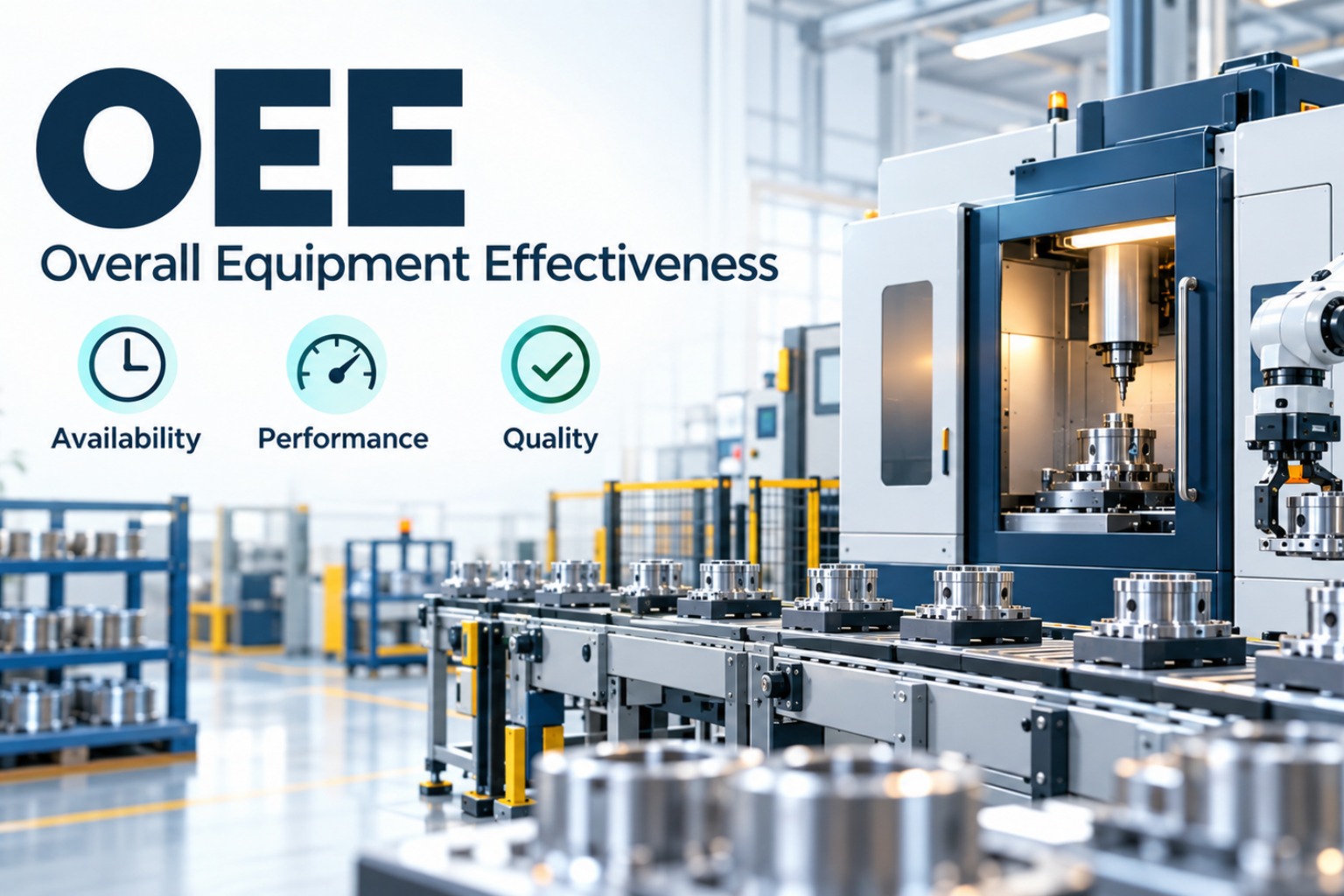
OEE (Overall Equipment Effectiveness) measures how effectively manufacturing equipment is used during planned production time.
Production output alone does not reveal how much capacity is lost through downtime, reduced speed or defective products. OEE brings these losses together in a single metric, covering three factors: availability, performance and quality.
How Is OEE Calculated?
OEE = Availability × Performance × Quality
An accurate calculation requires clearly defined planned production time, run time, ideal cycle time, total production count and the number of products that meet quality requirements on the first pass.
Availability: How Much of the Planned Time Was the Equipment Running?
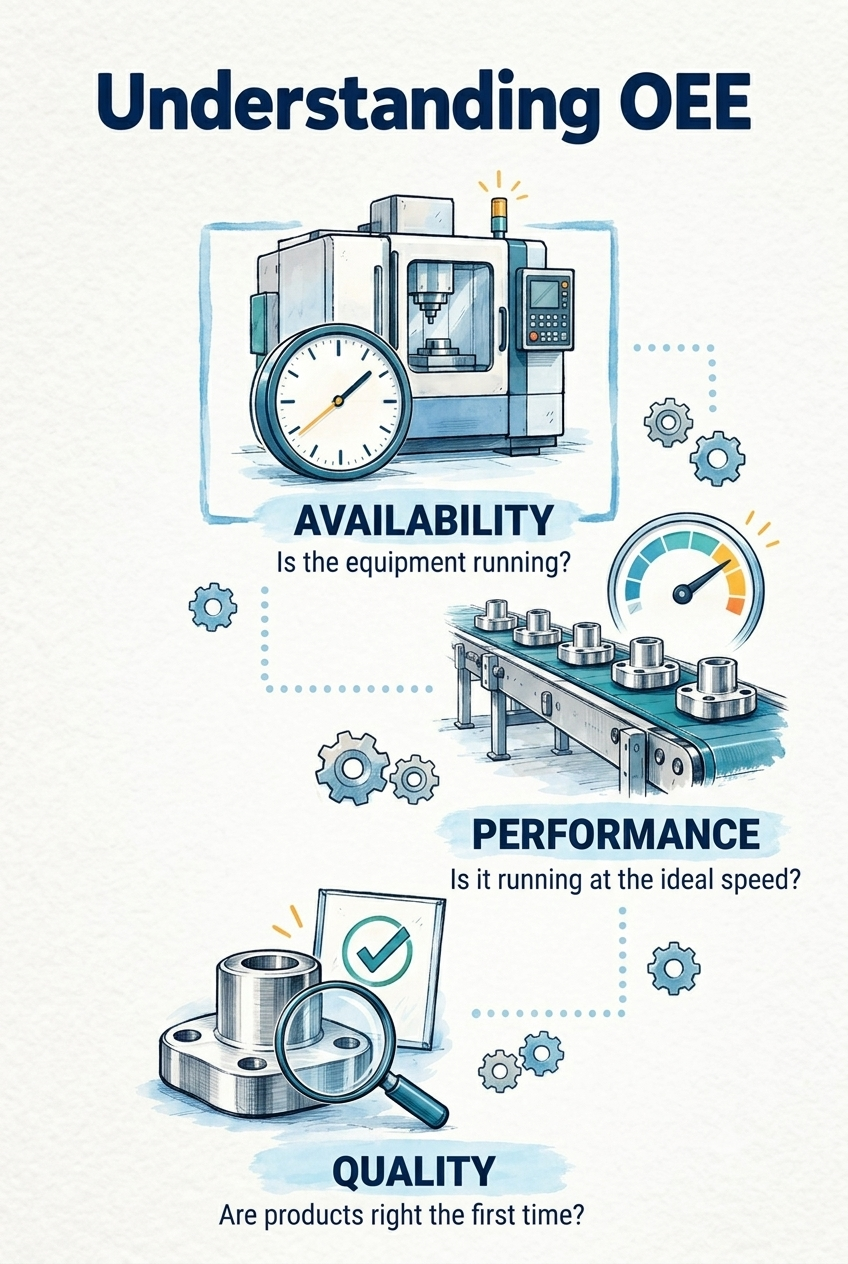
Availability measures the proportion of planned production time during which the equipment was running.
Availability = Run Time / Planned Production Time
Breakdowns, changeovers, adjustments, material shortages and other stops reduce availability. Changeovers and adjustments within planned production time count as availability losses, even when scheduled in advance.
Performance: How Fast Was the Equipment Producing?
Performance compares actual output with the output the equipment could achieve at its ideal speed.
Performance = (Ideal Cycle Time × Total Count) / Run Time
Reduced speed and minor stops lower performance. Ideal cycle time is the shortest achievable time to produce one unit under optimal conditions for the specific product and equipment. Using an overly generous cycle time can hide speed losses.
Quality: How Many Products Were Right the First Time?
Quality measures the proportion of products that meet requirements on the first pass, without rework.
Quality = Good Count / Total Count
Scrap and products requiring rework represent quality losses. This applies even if reworked products eventually meet the required standards.

OEE Calculation Example
Consider a machine producing a single product during one shift:
|
Item |
Value |
|
Planned production time |
480 minutes |
|
Downtime, including changeovers |
60 minutes |
|
Run time |
420 minutes |
|
Ideal cycle time |
1 minute per unit |
|
Total count |
350 units |
|
Good count, without rework |
336 units |
The three factors are calculated as follows:
- Availability: 420 / 480 = 87.5%
- Performance: (1 × 350) / 420 = 83.3%
- Quality: 336 / 350 = 96.0%
Multiplying the factors as decimal values gives:
OEE = 0.875 × 0.8333 × 0.96 = 70.0%
This means that 70% of planned production time was fully productive: equivalent to producing good products at the ideal speed with no stops. The remaining 30% represents losses from downtime, reduced speed and quality defects.
What Does the OEE Result Tell Us?
The overall result indicates the combined impact of losses, while the individual factors help identify where those losses occur.
|
If the main issue is low… |
Investigate… |
|
Availability |
Breakdowns, changeover and setup times, and other causes of downtime |
|
Performance |
Minor stops, reduced operating speed and the accuracy of the ideal cycle time |
|
Quality |
Scrap, rework and defects during startup |
The same OEE score can reflect very different problems. One machine may suffer mainly from breakdowns, another from reduced speed, and a third from quality losses. Always review all three factors alongside the overall percentage.
OEE alone does not explain root causes. Understanding them requires information about individual losses and the circumstances in which they occur.
What Should You Consider When Tracking OEE?
Meaningful results depend on consistent measurement rules. Clearly define which time is included in the calculation, how stops are recorded and which ideal cycle times apply.
When comparing machines or reporting periods, account for differences in products and operating conditions. OEE is not a direct measure of employee performance or overall business performance.
A higher OEE is valuable when it contributes to better production outcomes. Producing unnecessary quantities simply to improve the score can increase inventory without creating value for the customer.
The purpose of OEE is to understand losses, focus improvement efforts and verify their impact.
How Can You Get Started with OEE?
Start with a machine or production line where losses have a significant impact on production results. Involve the people who operate and maintain the equipment, agree on measurement rules and establish a brief, regular review of losses.
Next, select one significant problem and complete the improvement cycle, from root cause analysis to checking the results. This gives the team practical experience in turning production data into meaningful improvements.
DEMETRA Lean Way helps companies introduce Lean practices, identify production losses and establish a systematic approach to process improvement.
Would you like to use OEE to drive measurable improvements? Contact us to define the first steps for your production environment.