Most organisations do not suffer from a lack of strategy.
They suffer from a lack of execution.
Leadership teams spend weeks defining strategic priorities, setting annual objectives, approving budgets and reviewing KPIs. Yet months later, many organizations still struggle with the same operational problems:
- Productivity targets are missed.
- Improvement projects stall.
- Audits identify recurring findings.
- Daily meetings generate discussions but not actions.
- KPIs are reviewed but rarely improved.
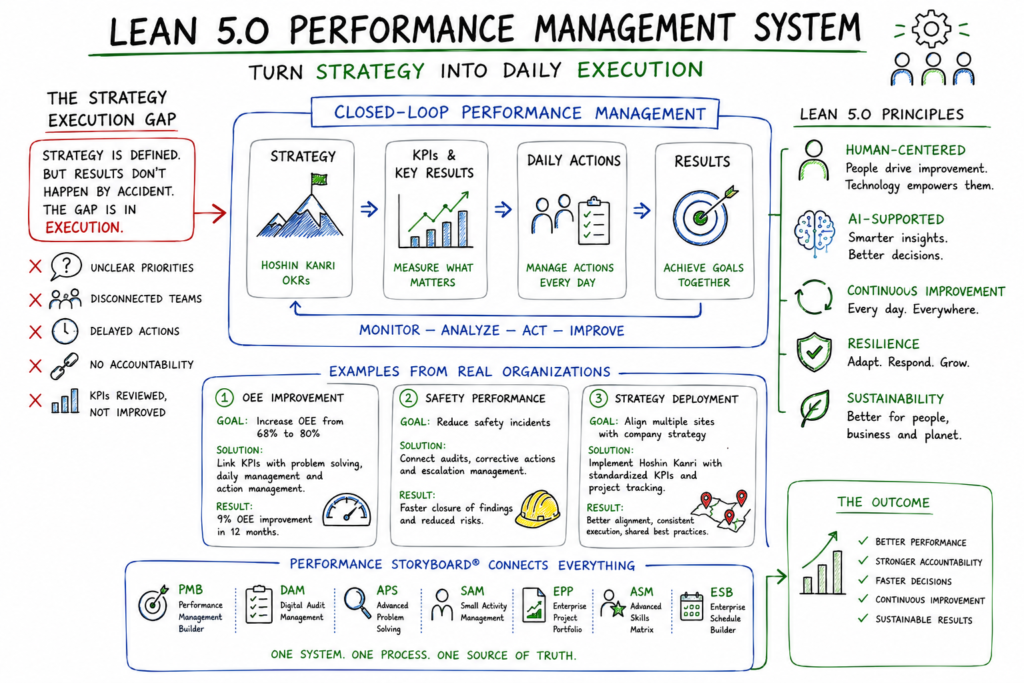
This challenge is known as the Strategy Execution Gap.
It is one of the largest hidden sources of performance loss in modern organizations.
The problem is rarely the strategy itself.
The problem is the inability to translate strategy into consistent daily execution.
The Strategy Execution Gap: The Biggest Hidden Loss in Modern Organizations
In many manufacturing organizations, KPI reviews gradually become reporting sessions rather than decision-making sessions.
Managers spend significant time discussing results but far less time managing actions.
The symptoms are familiar:
- Strategic objectives are unclear at operational levels.
- Teams focus on local priorities rather than company objectives.
- Corrective actions are delayed.
- Improvement projects operate independently from business goals.
- Employees struggle to understand how their work contributes to company success.
As a result, organizations create plans but fail to create results.
This is exactly where a Lean 5.0 Performance Management System creates value.
What Is a Lean 5.0 Performance Management System?
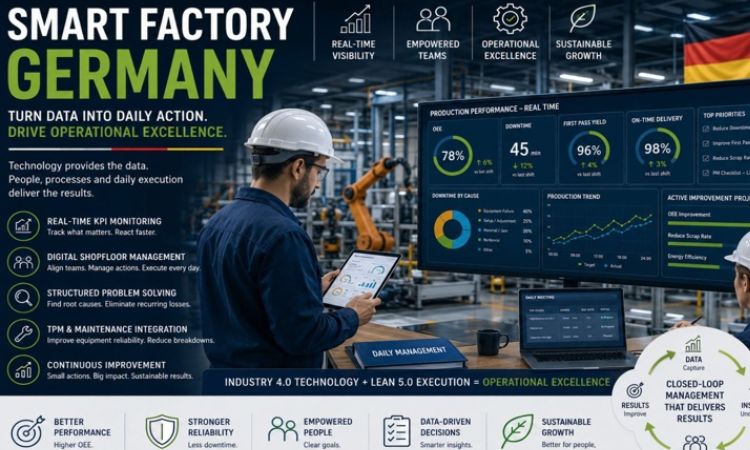
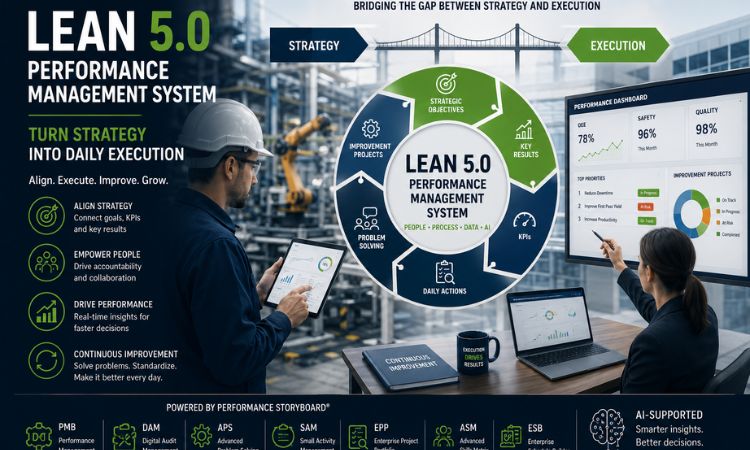
A Lean 5.0 Performance Management System is a structured management framework that connects strategy, people, processes, KPIs and AI-supported decision-making into one integrated execution system.
The objective is simple:
Turn strategy into measurable results.
Unlike traditional performance management systems that focus primarily on reporting and analytics, Lean 5.0 focuses on execution.
The system connects:
- Strategic Objectives
- Hoshin Kanri
- OKRs (Objectives and Key Results)
- Key Results
- KPIs
- Daily Management Systems
- Audits
- Problem Solving
- Improvement Projects
- Competence Development
- Tasks and Actions
into one continuous management process.
Why Traditional Performance Systems Fall Short
Most organizations already have access to large amounts of data.
They have:
- ERP systems
- MES platforms
- Business Intelligence tools
- OEE dashboards
- Production reports
- KPI scorecards
Yet operational performance often remains below expectations.
Why?
Because information alone does not improve performance.
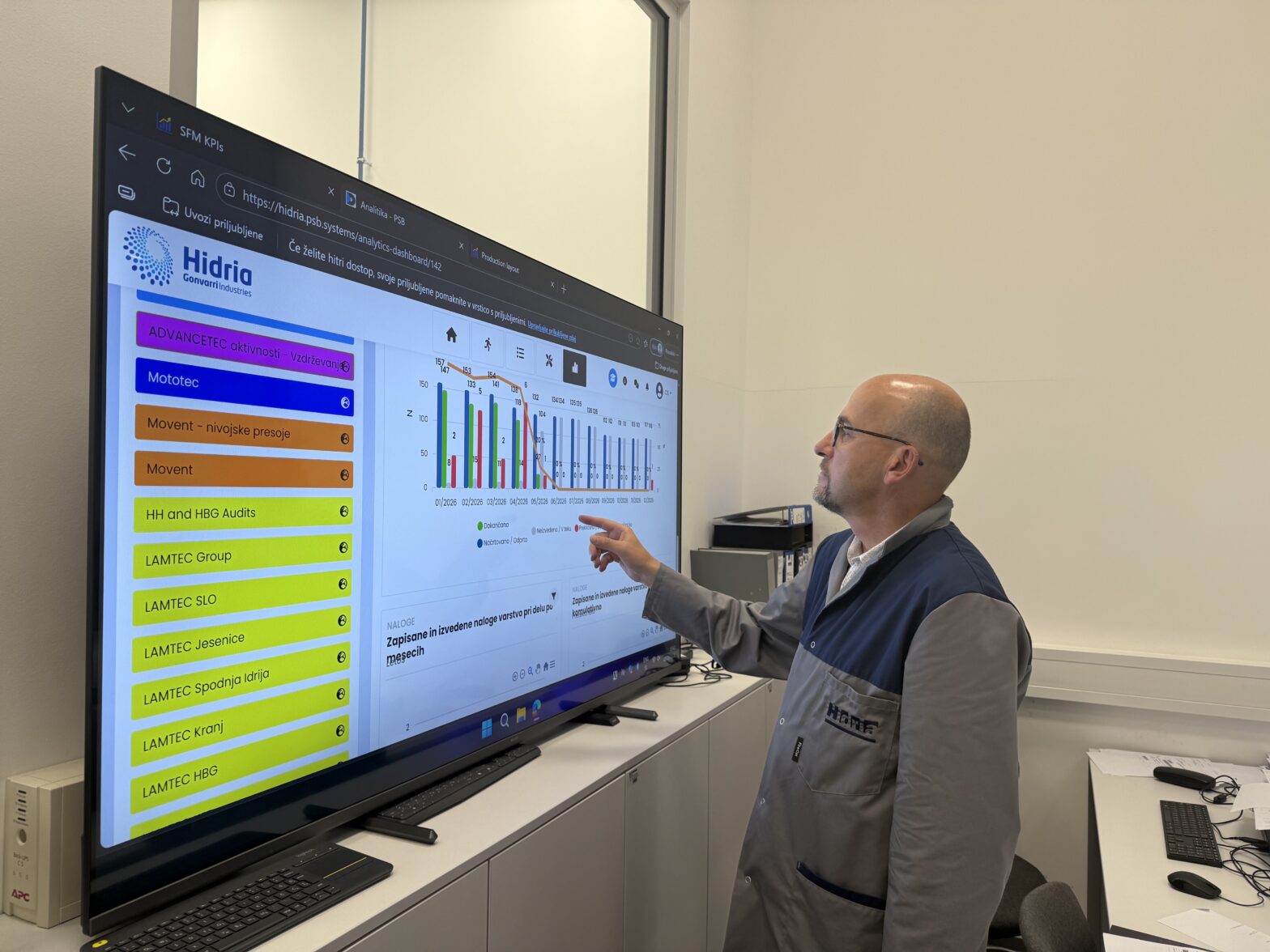
Dashboards show what happened.
Reports explain what happened.
Performance improves only when people take action.
Without ownership, accountability and follow-up, even the best reporting systems become passive information repositories.
Lean 5.0 Is Not Industry 4.0 Plus AI
Many organizations mistakenly assume that Lean 5.0 simply means adding Artificial Intelligence to Industry 4.0 technologies.
The reality is different.
Industry 4.0 focused primarily on:
- Connectivity
- Automation
- IoT
- Data collection
- Digitalization
Lean 5.0 expands the focus toward:
- Human-centered operations
- Competence development
- AI-assisted decision-making
- Organizational resilience
- Sustainability
- Collaboration between people and technology
Technology remains important.
However, people remain the primary driver of improvement.
The objective is not replacing people.
The objective is helping people make better decisions faster.
From Strategy to Daily Execution
One of the most powerful concepts in Lean 5.0 is alignment.
Every employee should understand how daily activities contribute to strategic objectives.
This creates a direct connection:
Strategy → Objectives → Key Results → KPIs → Daily Actions → Results
When a KPI deviates from target:
- The issue becomes visible.
- Ownership is assigned.
- Root cause analysis is initiated.
- Actions are created.
- Progress is monitored.
- Results are verified.
This creates a true execution management system rather than a reporting system.
Hoshin Kanri, OKRs and Lean 5.0
Many organizations struggle because strategy deployment remains disconnected from daily operations.
Methods such as Hoshin Kanri and OKRs provide powerful frameworks for translating strategy into execution.
However, these methods only succeed when supported by daily management processes.
A Lean 5.0 Performance Management System provides the missing link by connecting:
- Strategic priorities
- Annual objectives
- Key Results
- Operational KPIs
- Daily management routines
- Improvement activities
into a single management framework.
This ensures that strategic objectives remain visible and actionable at every organizational level.
Practical Example 1: Improving OEE Through Execution Management
A manufacturing company set a strategic objective to increase OEE from 68% to 80%.
The KPI was visible to everyone.
The target was clearly defined.
Yet progress remained slow.
Root Cause
No clear ownership existed for performance losses.
Downtime causes were discussed but not systematically addressed.
Implemented Solution
The organization connected:
- OEE KPIs
- Problem Solving
- Daily Management Meetings
- Action Management
into a single execution process.
Result
- Faster loss elimination
- Better accountability
- Improved cross-functional collaboration
- 9% OEE improvement within twelve months
The KPI itself did not improve performance.
The management system did.
Practical Example 2: Improving Safety Performance
A production facility wanted to reduce recurring safety incidents.
Initial Situation
Safety audits identified issues regularly.
Corrective actions were often delayed.
Implemented Solution
The organization connected:
- Digital audits
- Corrective actions
- Escalation management
- Daily reviews
into one integrated process.
Result
- Faster closure of findings
- Improved visibility
- Better ownership
- Reduced safety risks
Practical Example 3: Strategy Deployment Across Multiple Sites
A manufacturing group wanted to align multiple plants around the same strategic objectives.
Challenge
Each location tracked different KPIs and improvement initiatives.
Implemented Solution
The organization implemented a common Hoshin Kanri framework supported by standardized KPI management and project tracking.
Result
- Better strategic alignment
- Consistent reporting
- Faster sharing of best practices
- Improved execution across all sites
AI and the Future of Performance Management
Artificial Intelligence is rapidly changing how organizations manage performance.
Modern AI-supported systems can:
- Detect recurring problems
- Predict operational risks
- Identify hidden losses
- Recommend corrective actions
- Support Root Cause Analysis
- Prioritize improvement opportunities
The objective is not autonomous management.
The objective is augmenting human decision-making.
Organizations that successfully combine human expertise with AI support will gain significant competitive advantages.
How Performance Storyboard® Supports Lean 5.0 Execution
Most software platforms manage individual processes.
Performance Storyboard® manages execution.
The platform connects:
- PMB – Performance Management Builder
- DAM – Digital Audit Management
- APS – Advanced Problem Solving
- SAM – Small Activity Management
- EPP – Enterprise Project Portfolio
- ASM – Advanced Skills Matrix
- ESB – Enterprise Schedule Builder
into one integrated AI-supported Lean 5.0 Performance Management System.
This enables organizations to connect:
- Strategy
- Key Results
- KPIs
- Audits
- Problem Solving
- Projects
- Competencies
- Tasks
- Daily Meetings
within a single management environment.
The result is greater transparency, stronger accountability and faster execution at every organizational level.
Benefits of a Lean 5.0 Performance Management System
Organizations that successfully implement Lean 5.0 principles typically achieve:
Operational Benefits
- Improved productivity
- Reduced waste
- Faster problem resolution
- Better KPI performance
- Increased operational stability
Leadership Benefits
- Better visibility
- Faster decision-making
- Stronger accountability
- Improved strategic alignment
Business Benefits
- Higher profitability
- Greater organizational resilience
- Sustainable operational excellence
- Stronger competitive advantage
Frequently Asked Questions
What is the difference between a KPI dashboard and a Performance Management System?
A KPI dashboard displays information. A Performance Management System connects information with ownership, actions, follow-up and measurable results.
Why do strategy execution initiatives fail?
Most fail because objectives, KPIs, actions and accountability are not connected within a structured management framework.
How is Lean 5.0 different from Lean 4.0?
Lean 5.0 expands beyond digitalization by emphasizing people, competence development, resilience, sustainability and AI-assisted decision-making.
What role does AI play in performance management?
AI helps organizations identify patterns, prioritize actions, support decision-making and accelerate continuous improvement.
Can Lean 5.0 be applied outside manufacturing?
Yes. Lean 5.0 principles can be successfully applied in logistics, healthcare, services, engineering and administrative environments.
The Future of Performance Management
The organizations that will outperform competitors over the next decade will not necessarily be those with the most technology.
They will be those that execute strategy most effectively.
The future belongs to organizations that can connect strategy, people, KPIs, actions and AI into one integrated execution system.
Because performance does not improve when organizations measure more.
Performance improves when organizations execute better.