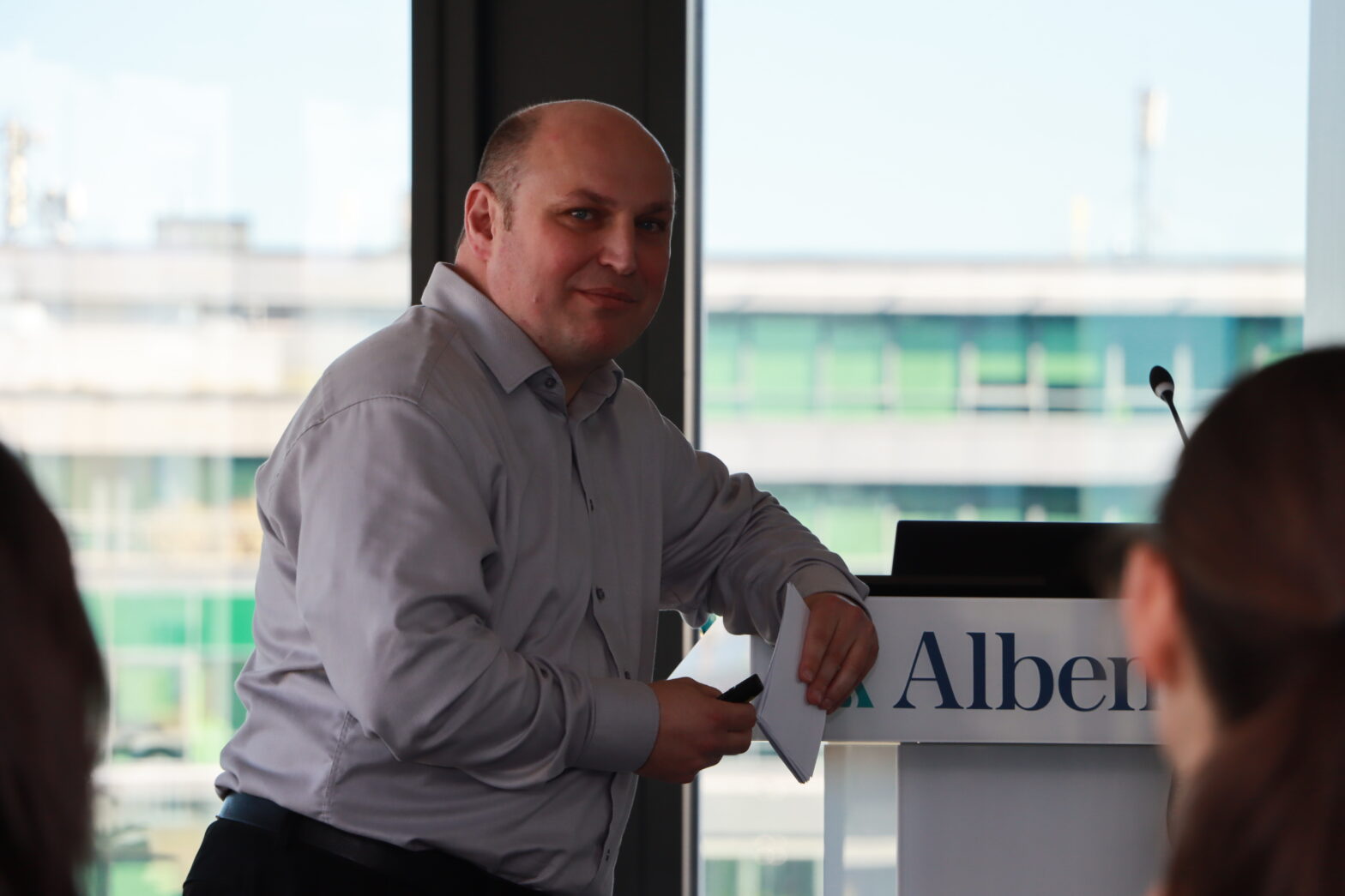
Gergely Szabó is a Lean Six Sigma Black Belt with many years of international experience in the fields of operational excellence, competency development, process management, and digital transformation. His work focuses primarily on connecting data, decision-making, and the actual execution of improvements in the daily work of teams.
His approach is based on a highly practical understanding of modern organizational challenges. Today, companies often have access to enormous amounts of data, dashboards, and KPIs, yet still struggle to achieve sustainable improvements. In his view, the main problem is usually not technology itself, but rather behavior, leadership culture, people development, and the lack of a clear management and decision-making system.
Through numerous international projects, he has helped organizations move from simple reporting to real performance management — from structured problem solving and management system development to building a culture of continuous improvement, accountability, and ownership.
His perspective on digital transformation is particularly interesting. Gergely emphasizes that digitalization is not a project with a “go-live” date, but rather an organization’s ability to continuously adapt, learn, and improve the way it works. Technology alone does not create results — results are created by people, leadership practices, and the organization’s ability to transform data into timely decisions and concrete actions.
In the interview, he speaks very directly about:
- why KPIs often become only reporting tools instead of management tools,
- where companies most frequently lose the connection between data and execution,
- why most organizations solve symptoms instead of root causes,
- and why competency development, ownership, and systems thinking are critical for long-term success.
At LEAN AKADEMIJA 2026, he will share practical experiences on how to build a culture of continuous improvement, develop team competencies, and use digital tools in a way that simplifies work, reduces waste, and supports long-term operational excellence.
Gergely Szabó is dedicated to hands‑on continuous improvement, supporting people in their development through structured problem‑solving, personal coaching, and project coaching.
Many companies already have data, dashboards, and KPIs. Why do so many still struggle to improve performance?
Because data alone doesn’t change behavior and without behavior change how we improve performance. Most organizations invest heavily in what to measure (and hopefully how to measure), but far less in:
- Capability – Do people know how to interpret the data?
- Ownership – Is anyone accountable for acting on it?
- Structure – Is there a routine where data leads to decisions?
In many cases, KPIs become reporting artifacts, not management tools. Without investing in people development, problem-solving skills, and a clear management system, dashboards only describe problems — they don’t solve them.
Data vs. action: “Where do you most often see the gap between data and actual action in companies?”
Choose basically any kind of KPI. (like SLA or backlog reporting)
If data clearly shows backlogs growing, SLA breaches recurring, peaks at month-end or quarter-end, the usual response are these: escalation emails, ad‑hoc firefighting or adding temporary capacity.
But what is really missing is root cause analysis:
- Why does the backlog build up every month?
- Which process step is the constraint?
- What decisions upstream drive the workload?
They are handling the symptoms, instead of causes.
Digitalization reality check: “What is the biggest misconception companies have about digital transformation today?
The biggest misconception about digital transformation is that it’s a project you can finish. Many companies treat it as something with a roadmap and a go‑live date. In reality, digital transformation is an ongoing capability — the ability to continuously adapt how decisions are made, how work flows, and how teams learn from data. Organizations struggle when they digitize existing ways of working without changing management habits. The real differentiator isn’t reaching an end state — it’s building the discipline to evolve continuously, at scale.
Lean practice: “Can you share an interesting anecdote or experience from implementing changes?
The team of the project manager I coached provided IT support to a British telecommunications service provider. The project focused on how customer complaints and incident tickets could be handled faster and more efficiently.
Based on the root cause analysis, many excellent improvement ideas were identified. However, most people were skeptical about whether the majority of these could actually be implemented, as they would have required changes primarily in the customer’s mindset and working methods.
I suggested that we give it a try—after all, what did we have to lose? An opportunity arose for the team to meet the customer in person. I prepared the project manager on how to introduce and propose the changes we would need.
The meeting went extremely well. The customer was genuinely pleased that we were working toward providing them with a better service and proved to be fully cooperative. We were able to clearly demonstrate the benefits they would gain from the changes.
As a result, service quality improved, everyone became more satisfied, and—thanks to the personal meeting and joint collaboration—a relationship of trust was established. From that point on, issues could be discussed directly with the responsible colleagues, even over the phone, instead of spending days exchanging emails.
Practical takeaway: “If a company wants to move from reporting to real performance management — what should they start doing differently tomorrow?
- Reduce the number of KPIs that are you using today. Focus on a few metrics that truly reflect customer value and flow — not everything that is easy to measure.
- Use a balanced Leading–Lagging KPI framework: Leading indicators to manage and adjust processes. Lagging indicators to confirm whether goals were achieved.
Leadership & system thinking: “How important is having a clear management system compared to just having the right tools?
A clear management system is far more important than having the right tools.
Tools are enablers, but a management system defines how decisions are made, how work is prioritized, how performance is reviewed, and how problems are solved. Without a coherent system, tools become isolated activities—used inconsistently, abandoned under pressure, or applied only by experts.
Future perspective: “What will differentiate high-performing companies in the next 3–5 years?
High‑performing companies will not be defined by technology alone, but by how well they combine technology, leadership, and adaptability and how they develop their people.
Event connection: “What will participants gain from your session at LEAN ACADEMY 2026?
Participants gain insights how continuous improvement mindset and framework can be applicable in a shared service hub and how we build capabilities, empower our teams, and leverage digital tools to simplify work, eliminate waste, and create a culture where improvement is everyone’s responsibility.
Optional: “Do you think most digitalization projects fail — not because of technology, but because of how companies operate?
Yes, absolutely. Technology rarely fails.
What fails is unclear ownership, lack of standard processes, weak problem-solving culture, and misaligned leadership behaviors.
Digitalization exposes organizational weaknesses. Companies that address those weaknesses succeed. Those that don’t — struggle, no matter how good the technology is.