German manufacturing has invested billions in Industry 4.0 technologies.
Factories are equipped with sensors, connected machines, MES platforms, ERP systems, production dashboards and advanced analytics.
Yet many manufacturers continue to face the same challenges:
- OEE remains below target.
- Downtime continues to disrupt production.
- Improvement initiatives lose momentum.
- Problems reoccur despite extensive reporting.
- Teams struggle to translate data into action.
The challenge is not technology.
The challenge is execution.
A Smart Factory is not created when machines become connected.
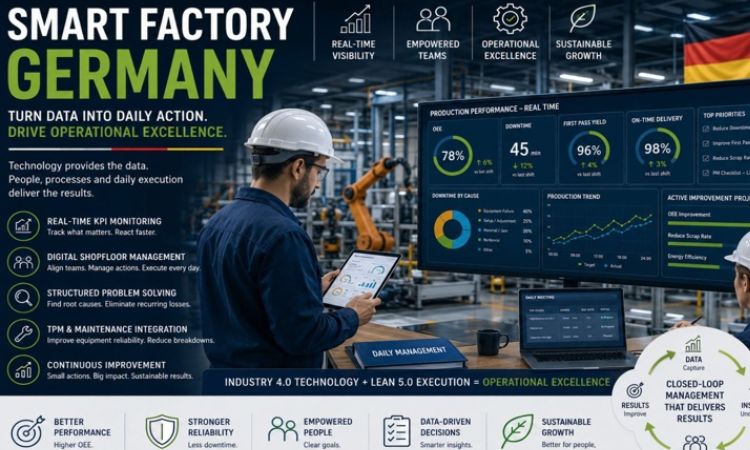
A Smart Factory is created when people, processes, technology and daily execution work together to improve performance.
This is where many digital transformation initiatives succeed—or fail.
Why Many Smart Factory Projects Fail
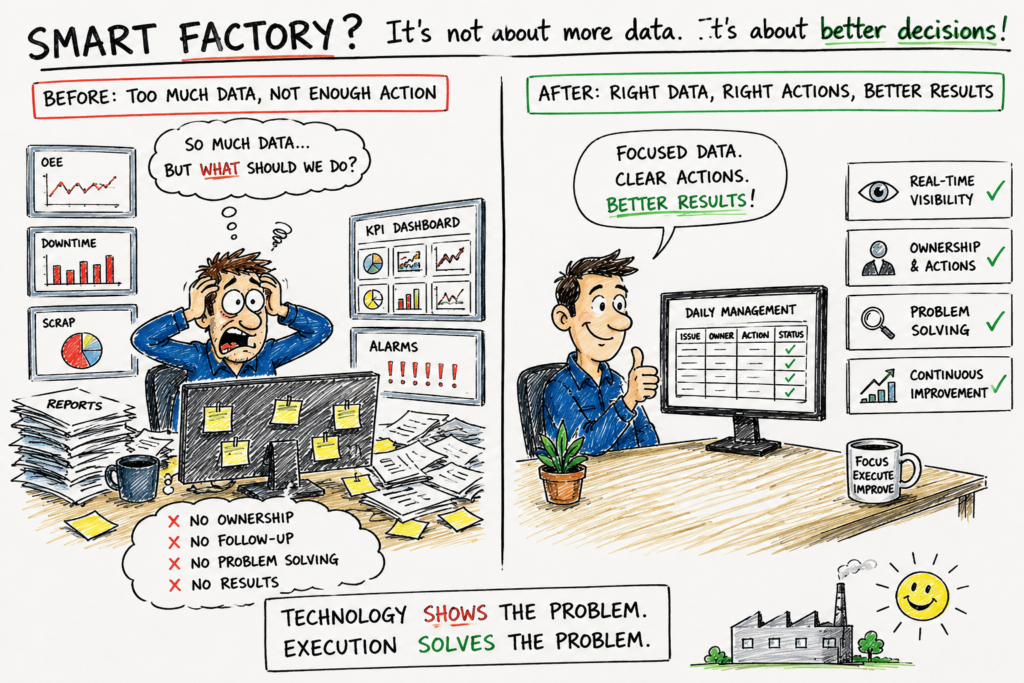
One of the most common misconceptions in manufacturing is the belief that more data automatically leads to better performance.
In reality, many organizations already have access to more operational data than they can effectively use.
The typical situation looks familiar:
- Machines generate real-time information.
- Dashboards display dozens of KPIs.
- Reports are available instantly.
- Performance reviews happen regularly.
Yet operational results improve far more slowly than expected.
Why?
Because visibility alone does not create improvement.
The most common reasons Smart Factory initiatives fail include:
- Too much focus on technology
- Limited ownership of KPIs
- Weak daily management routines
- Slow escalation of problems
- Lack of structured problem solving
- Improvement activities disconnected from business objectives
- Insufficient follow-up of actions
Technology can reveal problems.
Only people can solve them.
What Is a Smart Factory?
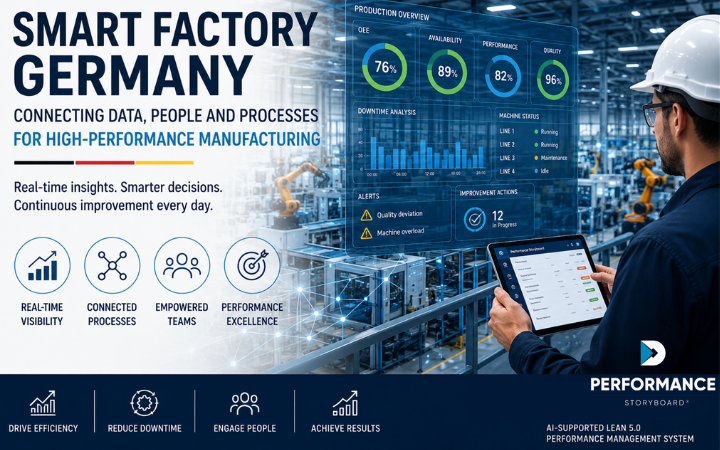
A Smart Factory is a manufacturing environment where technology, data, people and processes work together to improve operational performance continuously.
The objective is not simply automation.
The objective is operational excellence.
A successful Smart Factory enables organizations to:
- Improve productivity
- Increase OEE
- Reduce downtime
- Improve quality performance
- Strengthen decision-making
- Accelerate continuous improvement
- Increase organizational agility
The best Smart Factories are not data-driven.
They are action-driven.
From Industry 4.0 to Industry 5.0
Industry 4.0 transformed manufacturing through:
- Connectivity
- Automation
- IoT
- Data collection
- Digitalization
These technologies remain essential.
However, Industry 5.0 expands the focus.
The next generation of manufacturing emphasizes:
Human-Centered Operations
Technology should support people rather than replace them.
Competence Development
Employees must be equipped to interpret data, solve problems and drive improvement.
AI-Assisted Decision-Making
Artificial Intelligence helps teams identify risks, prioritize actions and improve response times.
Organizational Resilience
Factories must adapt quickly to changing market conditions, supply chain disruptions and customer requirements.
Sustainability
Operational excellence must support long-term economic, environmental and social performance.
The future belongs to organizations that successfully combine digital technologies with human capabilities.
Smart Factory Solutions That Create Real Results
Technology investments create value only when integrated into structured management systems.
The most successful Smart Factory environments combine several critical elements.
Real-Time KPI Management
KPIs provide visibility into operational performance.
Important manufacturing KPIs often include:
- OEE
- Downtime
- First Pass Yield
- Scrap Rate
- Maintenance Compliance
- On-Time Delivery
- Safety Performance
However, KPI visibility alone is not enough.
Organizations must establish ownership, accountability and action management around KPI performance.
Digital Shopfloor Management
Traditional whiteboards remain valuable.
However, modern manufacturing environments require:
- Real-time updates
- Multi-site visibility
- Digital escalation workflows
- Action tracking
- Standardized meeting routines
Digital Shopfloor Management creates faster communication, stronger alignment and better execution.
Structured Problem Solving
Operational excellence depends on eliminating root causes rather than treating symptoms.
Effective Smart Factory systems support:
- Root Cause Analysis
- Corrective Actions
- Countermeasure Verification
- Knowledge Sharing
- Standardization
This prevents recurring losses and accelerates learning.
TPM and Equipment Reliability
A Smart Factory cannot achieve operational excellence without reliable equipment.
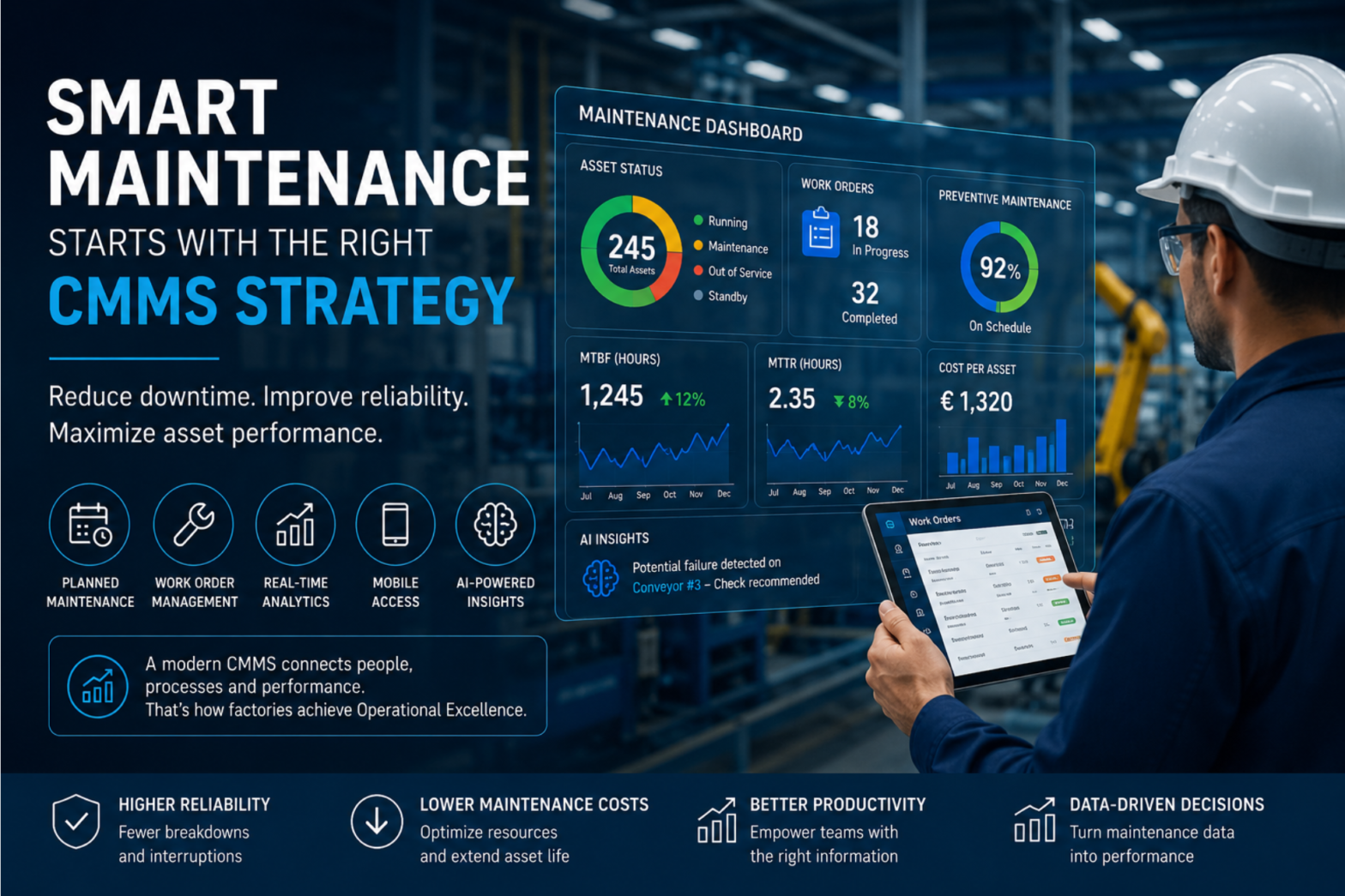
Integrating TPM (Total Productive Maintenance) into digital workflows helps organizations improve:
- Planned Maintenance
- Autonomous Maintenance
- Breakdown Reduction
- Asset Reliability
- Maintenance KPI Performance
Reliability remains one of the strongest drivers of sustainable manufacturing performance.
The Missing Link: From Data Visibility to Daily Execution
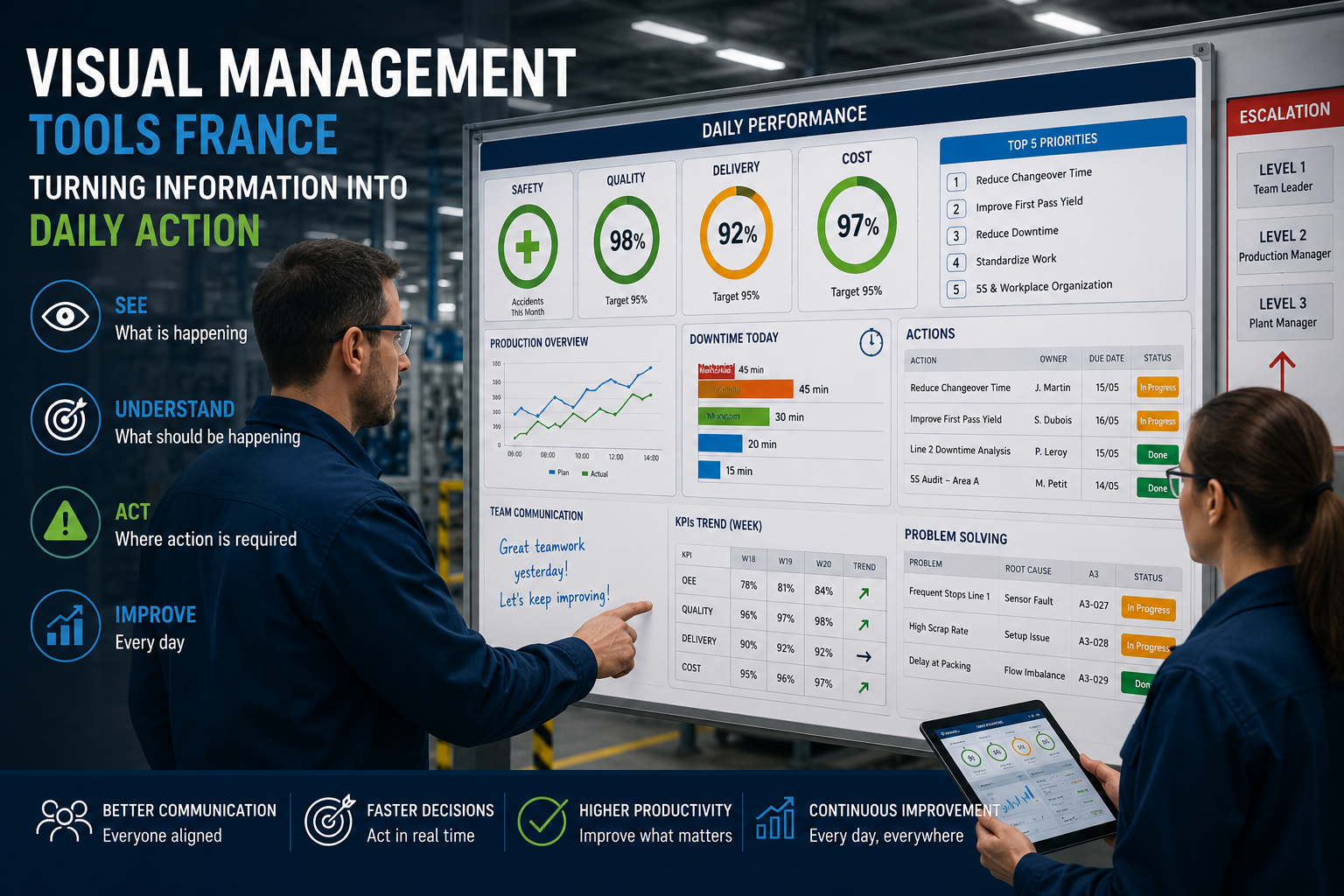
Many factories already have dashboards.
Many factories already have reports.
Many factories already have KPIs.
The real challenge is ensuring that every deviation leads to action.
Operational excellence requires a closed-loop management process:
Data → Visibility → Ownership → Action → Verification → Improvement
Without this connection, organizations simply collect information without improving performance.
This is where the concept of Lean 5.0 becomes particularly important.
The focus shifts from monitoring performance to managing performance.
Practical Example 1: Improving OEE
A manufacturing facility targeted an increase in OEE from 70% to 80%.
The KPI was visible on multiple dashboards.
However, progress remained limited.
Root Cause
No structured ownership existed for recurring performance losses.
Implemented Solution
The company connected:
- OEE monitoring
- Daily management meetings
- Root cause analysis
- Action tracking
into one integrated execution process.
Result
- Faster loss elimination
- Improved accountability
- Better cross-functional collaboration
- Significant OEE improvement
The dashboard did not improve performance.
Execution did.
Practical Example 2: TPM and Maintenance Excellence
A factory experienced recurring equipment failures despite having preventive maintenance plans.
Challenge
Maintenance activities were planned but not consistently executed.
Implemented Solution
The organization integrated TPM routines with digital maintenance tracking and KPI monitoring.
Result
- Reduced breakdown frequency
- Improved maintenance compliance
- Higher equipment availability
- Increased production stability
Practical Example 3: Multi-Site Performance Alignment
A manufacturing group operated several plants across Europe.
Each location tracked performance differently.
Challenge
Limited visibility and inconsistent execution.
Implemented Solution
The company standardized KPI management, escalation routines and problem-solving processes across all locations.
Result
- Better strategic alignment
- Faster sharing of best practices
- Improved operational consistency
- Stronger management visibility
AI and the Future of Smart Manufacturing
Artificial Intelligence is rapidly becoming a critical component of Smart Factory development.
Modern AI-supported systems can:
- Detect anomalies
- Predict equipment failures
- Identify hidden losses
- Support Root Cause Analysis
- Prioritize improvement opportunities
- Recommend corrective actions
The objective is not autonomous factories.
The objective is better decision-making.
Organizations that successfully combine human expertise with AI support will gain significant competitive advantages.
How Performance Storyboard® Supports Smart Factory Excellence
Many digital platforms focus on collecting and displaying information.
Performance Storyboard® focuses on execution.
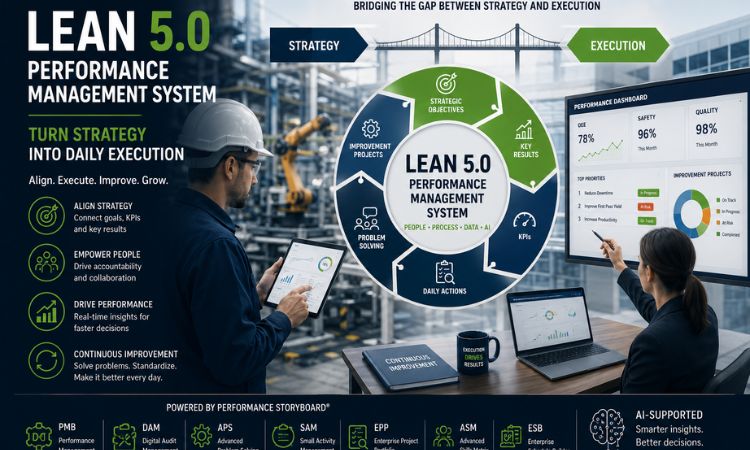
The platform connects:
- PMB – Performance Management Builder
- DAM – Digital Audit Management
- APS – Advanced Problem Solving
- SAM – Small Activity Management
- EPP – Enterprise Project Portfolio
- ASM – Advanced Skills Matrix
- ESB – Enterprise Schedule Builder
into one integrated AI-supported Lean 5.0 Performance Management System.
This enables organizations to connect:
- Strategy
- KPIs
- Daily Management Systems
- Audits
- Problem Solving
- Projects
- Competence Development
- Tasks
- Operational Execution
within a single management framework.
The result is greater transparency, stronger accountability and faster execution across the organization.
Frequently Asked Questions
What is the difference between a Smart Factory and Industry 4.0?
Industry 4.0 refers to the technologies that enable digital manufacturing. A Smart Factory is the practical application of these technologies within an operational environment.
Why do Smart Factory projects fail?
Most fail because organizations focus on technology while neglecting execution, accountability and continuous improvement processes.
Is a Smart Factory only about automation?
No. Smart Factories connect people, processes, technology and management systems to improve operational performance.
How does AI support Smart Manufacturing?
AI helps organizations identify risks, predict failures, prioritize actions and improve decision-making.
What role does Lean Management play in a Smart Factory?
Lean provides the management framework that transforms data and technology into operational improvement and sustainable business results.
The Future of Manufacturing in Germany
The factories that will outperform competitors over the next decade will not necessarily be those with the most technology.
They will be those that execute better.
The future belongs to organizations that successfully combine Industry 4.0 technologies, Lean principles, TPM practices, AI-supported decision-making and disciplined daily execution.
Because operational excellence is not created by collecting more data.
Operational excellence is created by turning data into action.