Most Factories Have More Data Than Ever. So Why Are Results Not Improving Faster?
Many German manufacturers have invested heavily in automation, MES systems, ERP platforms, IoT technologies and production analytics.
Yet despite these investments, many organizations continue to face familiar challenges:
- Productivity improvements are slower than expected
- Problems are identified too late
- Departments work in silos
- Continuous improvement initiatives lose momentum
- Operational decisions remain reactive
- Employees struggle to understand priorities
The issue is rarely a lack of technology.
The real challenge is execution.
A Smart Factory is not created when machines are connected.
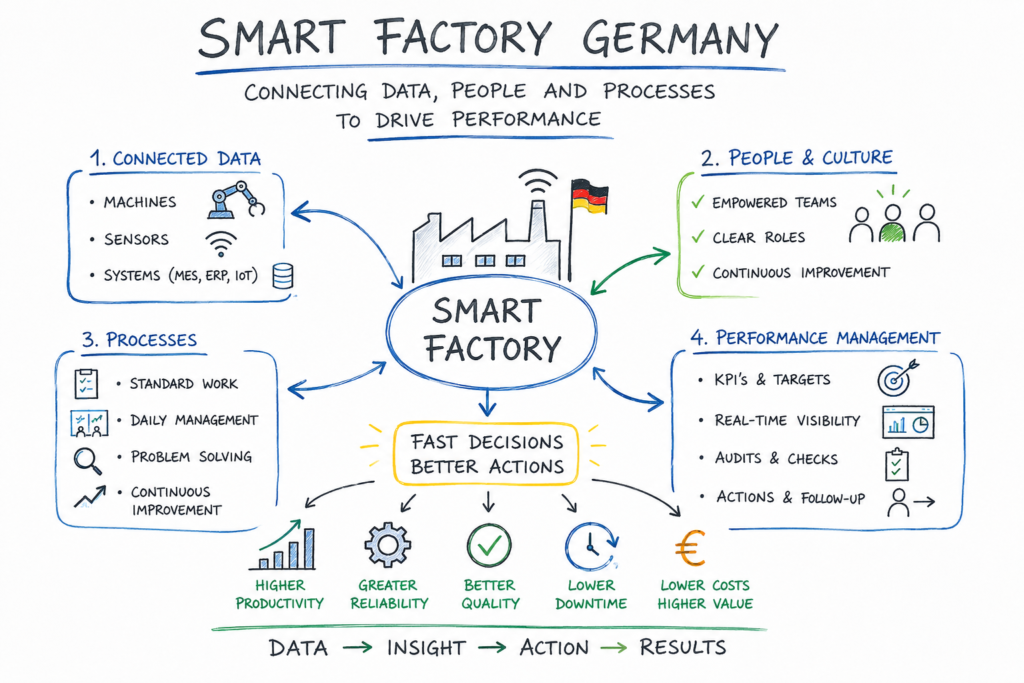
A Smart Factory is created when data, people, processes and decision-making are connected.
What Is a Smart Factory?
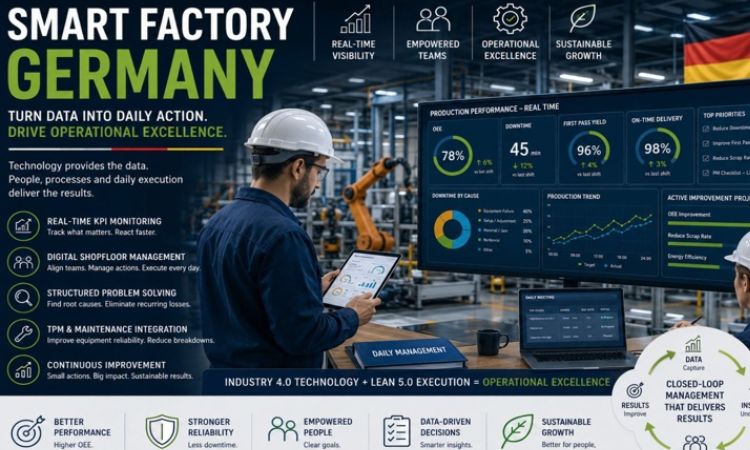
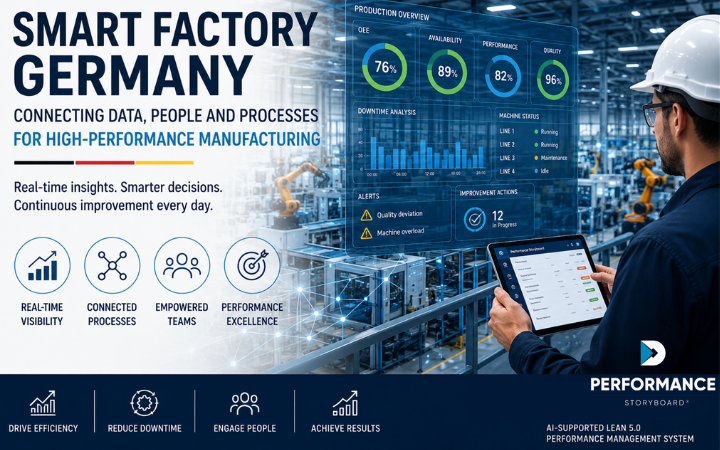
A Smart Factory is a manufacturing environment where operational data is continuously collected, analyzed and transformed into actions that improve performance.
The objective is not simply digitalization.
The objective is better business outcomes.
A successful Smart Factory enables organizations to:
- Improve productivity
- Reduce losses
- Increase equipment reliability
- Improve quality performance
- Accelerate decision-making
- Support continuous improvement
- Increase organizational agility
Technology is the enabler.
People and processes remain the drivers of performance.
Why Traditional Smart Factory Initiatives Often Underperform
Many companies successfully collect data but fail to convert information into action.
A typical situation looks like this:
- Machines generate real-time data
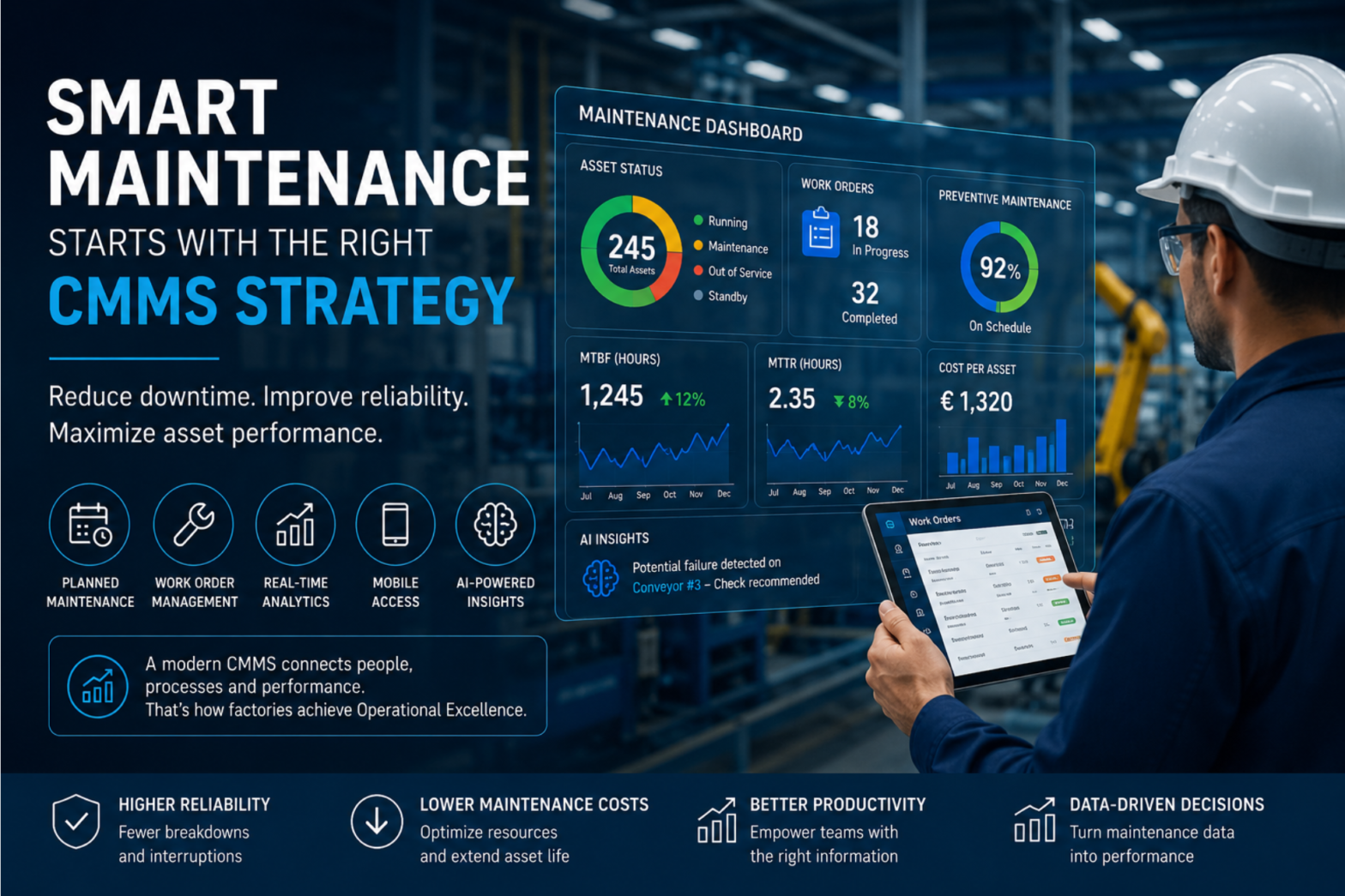
- Dashboards display KPIs
- Reports are available everywhere
Yet operational problems continue to repeat.
Why?
Because visibility alone does not improve performance.
Organizations often lack:
- Clear ownership
- Structured problem solving
- Daily management routines
- Cross-functional collaboration
- Follow-up mechanisms
- Accountability for execution
Data shows what is happening.
Management systems determine what happens next.
From Connected Machines to Connected Decisions
The next generation of Smart Factories focuses on decision-making rather than data collection.
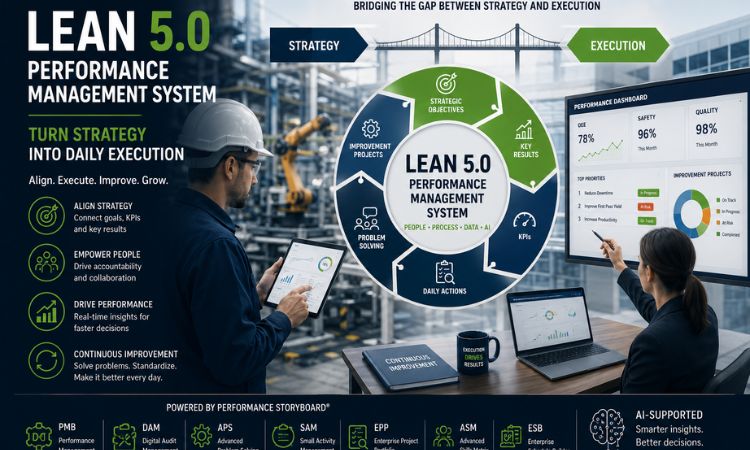
The most successful organizations connect:
- Strategy
- Objectives
- Key Results
- KPIs
- Audits
- Problem Solving
- Projects
- Competence Development
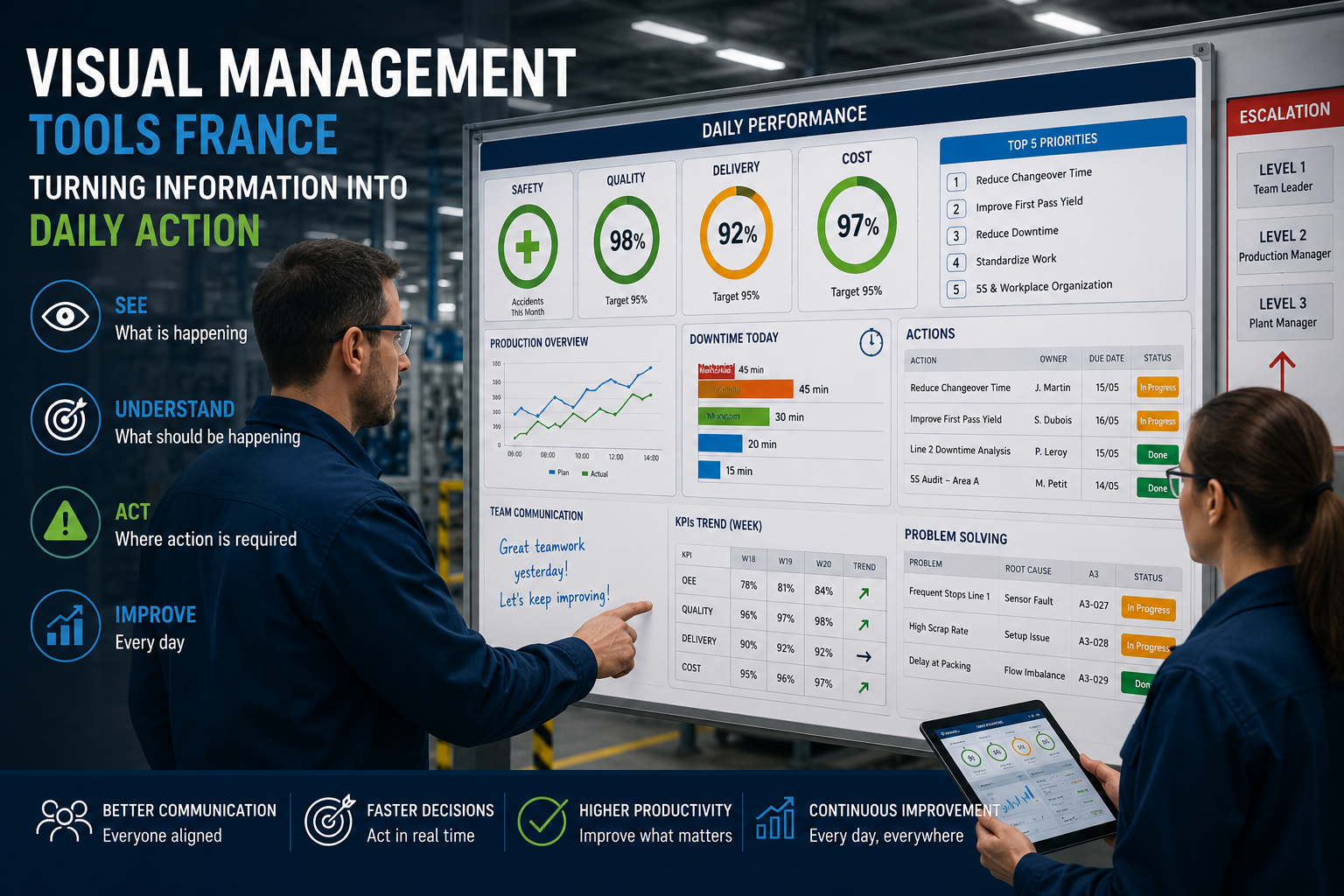
- Daily Management
This creates a digital execution system rather than a collection of disconnected technologies.
When a deviation occurs, the organization immediately knows:
- What happened
- Why it happened
- Who is responsible
- What action is required
- When it should be completed
- Whether the result was achieved
This is where real operational excellence begins.
Smart Factory and Lean 5.0
Industry 4.0 focused primarily on technology.
Industry 5.0 expands the perspective.
The focus shifts toward:
- Human-centered operations
- AI-assisted decision-making
- Workforce development
- Organizational resilience
- Sustainability
- Collaboration between people and technology
A modern Smart Factory therefore requires more than connected equipment.
It requires connected people.
Organizations that combine digital tools with Lean thinking consistently outperform organizations that focus only on technology.
The Growing Role of AI in Manufacturing
Artificial Intelligence is becoming one of the most important enablers of Smart Factory development.
Manufacturers increasingly use AI to:
- Detect production anomalies
- Predict equipment failures
- Identify performance trends
- Support root cause analysis
- Prioritize improvement opportunities
- Assist operational decision-making
The most successful applications do not replace people.
They help leaders and teams make better decisions faster.
This is one of the core principles of Lean 5.0.
Practical Example: Turning Data Into Measurable Improvement
A manufacturing company had already implemented:
- ERP
- MES
- OEE monitoring
- Automated production reporting
Despite having access to large amounts of operational data, productivity improvements remained limited.
Initial Challenges
- Too many disconnected reports
- No structured follow-up process
- Improvement actions frequently delayed
- Limited accountability
Implemented Approach
The organization introduced a structured performance management system that connected:
- Strategic objectives
- Operational KPIs
- Daily meetings
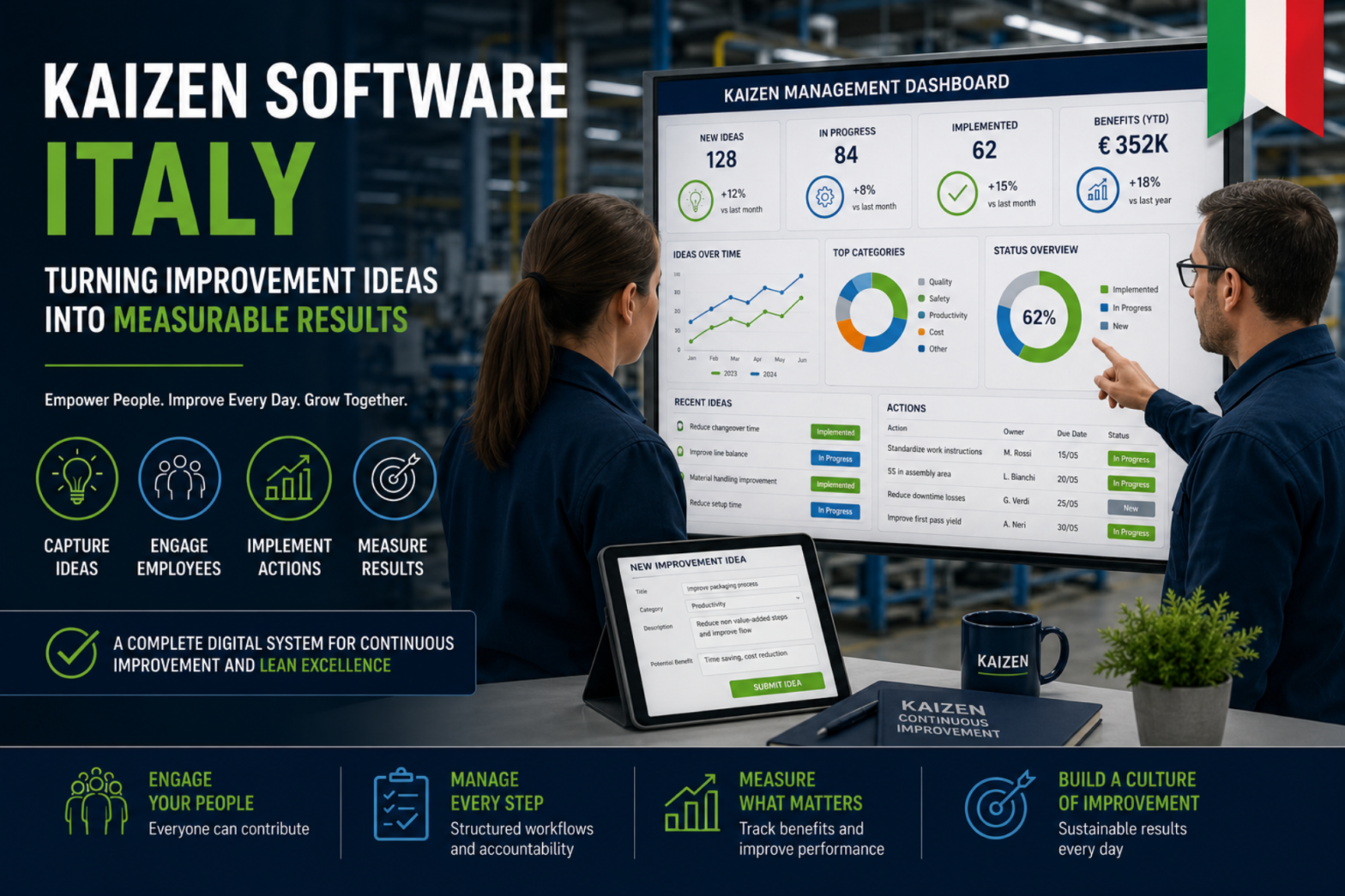
- Improvement actions
- Problem solving activities
Results
- Faster issue escalation
- Improved KPI ownership
- Better cross-functional collaboration
- Increased improvement activity
- Greater management visibility
The biggest lesson was clear:
Data did not create the improvement.
Execution did.
How Performance Storyboard Supports Smart Factory Initiatives
Many digital transformation projects focus on collecting information.
Performance Storyboard® focuses on executing improvement.
The platform helps organizations connect:
- Strategy deployment
- KPI management
- Daily Management Systems
- Digital audits
- Problem solving
- Improvement projects
- Competence management
- Task execution
Within a single digital environment.
This enables organizations to transform disconnected information into a structured Lean 5.0 Performance Management System.
The result is greater transparency, stronger accountability and faster execution across all organizational levels.
Benefits of a High-Performance Smart Factory
Organizations that successfully combine digital technologies with structured performance management typically achieve:
Operational Benefits
- Improved productivity
- Reduced downtime
- Higher OEE
- Better quality performance
- Faster response to deviations
Management Benefits
- Improved visibility
- Better decision-making
- Stronger alignment
- Greater accountability
- Faster execution
Strategic Benefits
- Increased competitiveness
- Greater organizational resilience
- Stronger continuous improvement culture
- Better scalability across multiple sites
Frequently Asked Questions
What is the difference between Industry 4.0 and a Smart Factory?
Industry 4.0 is a broader concept focused on digital technologies. A Smart Factory is the practical implementation of these technologies within manufacturing operations.
Is a Smart Factory only about automation?
No. Smart Factory initiatives must connect people, processes and technology to achieve measurable business results.
Can existing factories become Smart Factories?
Yes. Most organizations evolve gradually by integrating existing systems, improving visibility and establishing structured performance management processes.
How does AI support Smart Factory development?
AI helps organizations identify patterns, predict issues and improve decision-making across manufacturing operations.
What is the biggest reason Smart Factory projects fail?
Many organizations focus on data collection but neglect execution, accountability and continuous improvement processes.
The Future of Manufacturing in Germany
The factories that will outperform competitors over the next decade will not necessarily be those with the most technology.
They will be the organizations that best connect technology, people and execution.
The future of manufacturing belongs to companies that transform data into decisions, decisions into actions and actions into measurable business results.
That is the true objective of a Smart Factory.