Why Maintenance Still Fails in Many Factories
Many manufacturing companies have invested significantly in modern equipment, automation and production technologies. Yet maintenance departments are often still trapped in a reactive mode.
The symptoms are familiar:
- Frequent unplanned downtime
- Recurring equipment failures
- Maintenance plans managed in spreadsheets
- Poor visibility of maintenance activities
- Difficult coordination between production and maintenance teams
- Lack of reliable maintenance performance data
The problem is rarely a lack of effort. More often, maintenance information is fragmented, priorities are unclear and preventive maintenance activities are inconsistently executed.
This is where Maintenance Management Software (CMMS) becomes a critical component of a modern maintenance strategy.
What Is a CMMS?
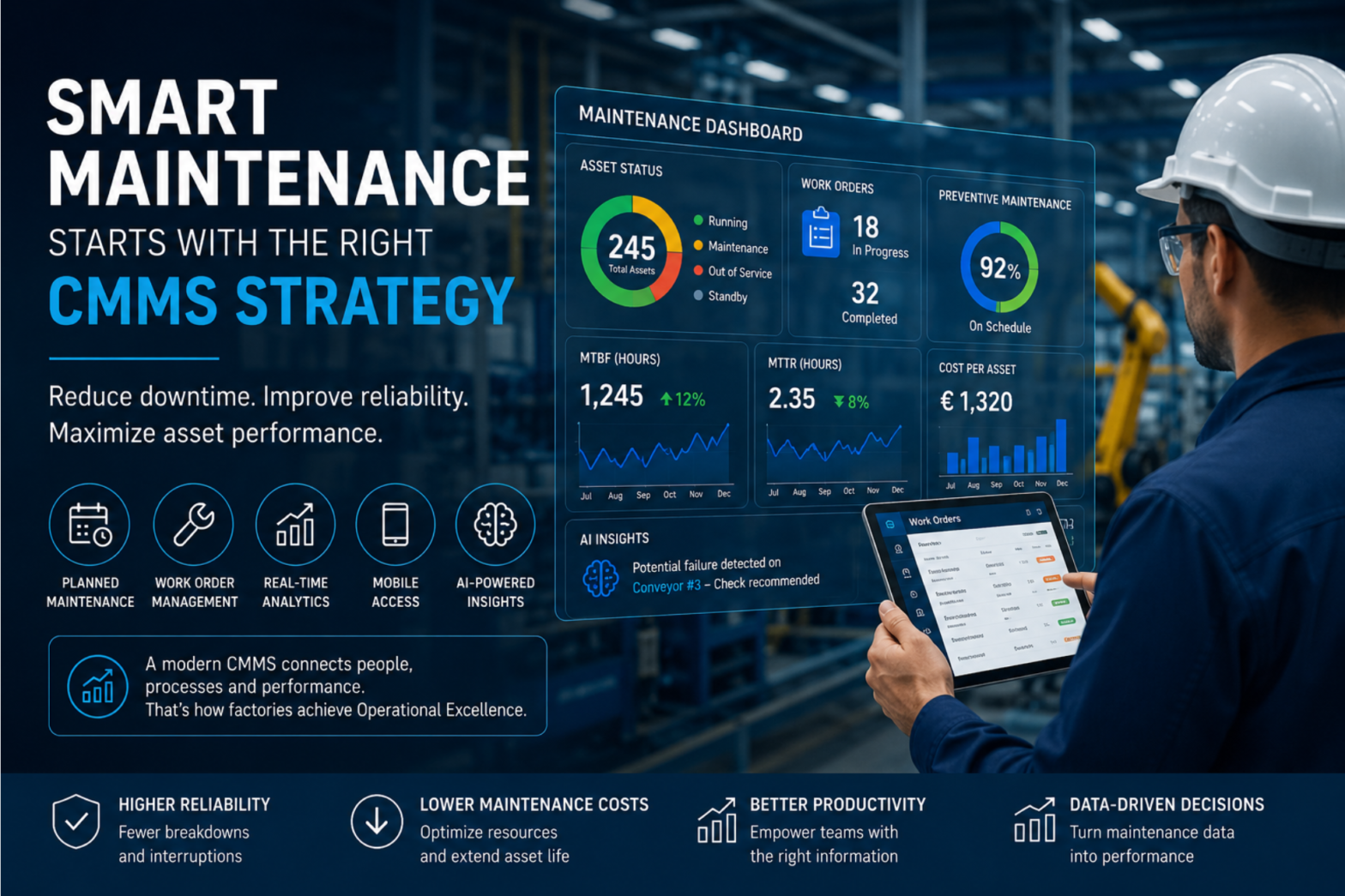
A Computerized Maintenance Management System (CMMS) is a digital platform designed to plan, manage, monitor and optimize maintenance activities across an organization.
A modern CMMS helps maintenance teams:
- Manage assets and equipment
- Schedule preventive maintenance activities
- Create and track work orders
- Monitor maintenance performance
- Improve documentation and compliance
- Analyze maintenance data for better decision-making
Instead of reacting to failures after they occur, organizations can establish a structured maintenance system focused on prevention, reliability and continuous improvement.
CMMS vs Traditional Maintenance Management
Many organizations still rely on spreadsheets, paper-based records or disconnected software tools.
While these approaches may work in small environments, they quickly become inefficient as operations grow.
| Traditional Approach | Modern CMMS |
| Manual planning | Automated scheduling |
| Reactive maintenance | Preventive and predictive maintenance |
| Spreadsheet-based tracking | Real-time visibility |
| Limited reporting | Advanced analytics |
| Difficult prioritization | Structured work management |
| Fragmented information | Centralized maintenance data |
The difference is not only digitalization. It is the ability to manage maintenance as a strategic business process.
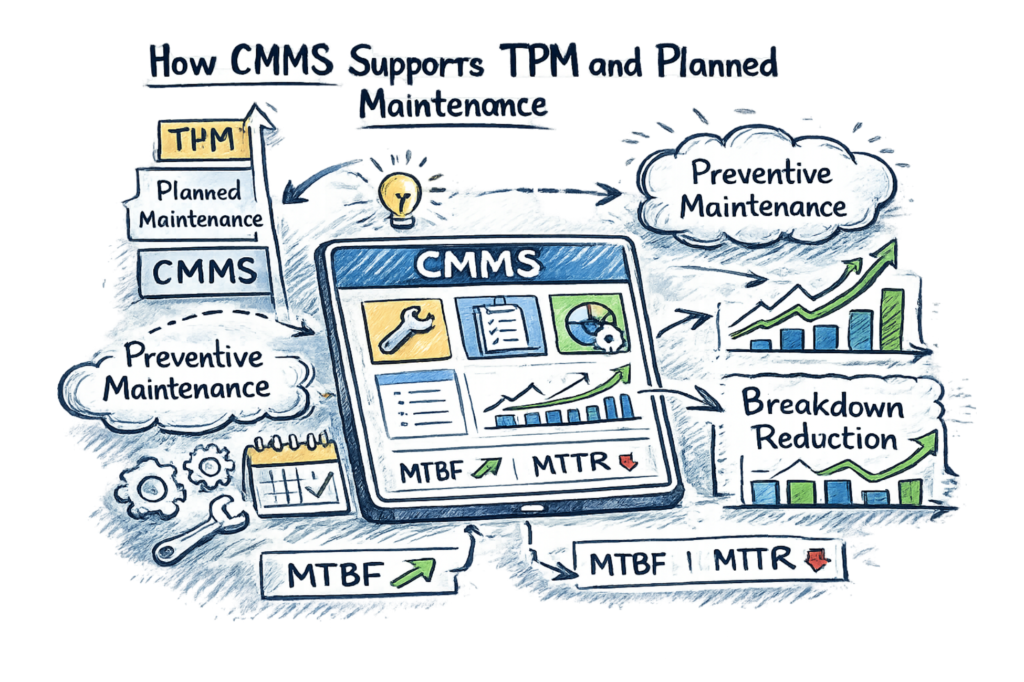
How CMMS Supports TPM and Planned Maintenance
One of the key pillars of TPM (Total Productive Maintenance) is Planned Maintenance.
The objective is simple:
Reduce failures, improve equipment reliability and increase overall equipment effectiveness.
A CMMS provides the foundation for achieving these goals by enabling:
- Preventive maintenance scheduling
- Standardized maintenance procedures
- Asset history tracking
- Failure analysis
- Spare parts management
- Maintenance KPI monitoring
Without a structured maintenance system, TPM initiatives often struggle to sustain results over time.
A well-implemented CMMS helps organizations move from firefighting toward proactive equipment management.
Maintenance KPIs Every Plant Should Monitor
Maintenance activities should always be connected to measurable performance indicators.
Some of the most important maintenance KPIs include:
MTBF (Mean Time Between Failures)
Measures equipment reliability by tracking the average operating time between failures.
MTTR (Mean Time To Repair)
Measures how quickly maintenance teams restore equipment after a failure.
Preventive Maintenance Compliance
Tracks whether planned maintenance activities are completed on schedule.
Maintenance Cost per Asset
Provides visibility into maintenance spending and asset performance.
Planned vs Reactive Maintenance Ratio
Indicates how much maintenance effort is proactive versus reactive.
OEE (Overall Equipment Effectiveness)
One of the most important indicators connecting maintenance performance with production results.
Organizations that monitor these KPIs consistently are significantly better positioned to improve reliability and reduce operational losses.
The Growing Role of AI in Maintenance Management
Artificial Intelligence is rapidly transforming maintenance practices.
Modern maintenance systems increasingly use AI to:
- Detect equipment anomalies
- Predict potential failures
- Prioritize maintenance activities
- Identify recurring failure patterns
- Support root cause analysis
- Recommend corrective actions
Rather than replacing maintenance professionals, AI helps them make faster and better decisions based on data.
This shift represents an important step toward Industry 5.0, where technology supports people rather than replacing them.
Practical Example: Reducing Downtime Through Digital Maintenance
A manufacturing company operating multiple packaging lines experienced frequent unexpected breakdowns.
Initial Situation
- Four to five major breakdowns per month
- Preventive maintenance performed inconsistently
- Maintenance records stored in spreadsheets
- Limited visibility of recurring failures
Implemented Solution
The company introduced a CMMS system to:
- Digitize maintenance schedules
- Standardize work orders
- Track equipment history
- Monitor maintenance KPIs
Results
- 37% reduction in unexpected breakdowns
- 22% increase in maintenance productivity
- Improved preventive maintenance compliance
- Higher equipment availability
- Improved OEE performance
The biggest lesson was not the software itself.
The real improvement came from establishing a structured maintenance management process supported by digital tools.
From CMMS to Lean 5.0 Performance Management
A CMMS is an essential building block of maintenance excellence.
However, maintenance performance cannot be managed in isolation.
The most successful organizations connect maintenance activities with:
- Strategic objectives
- Operational KPIs
- Daily Management Systems
- Audits
- Problem Solving processes
- Continuous Improvement initiatives
- Competence development
- Project management
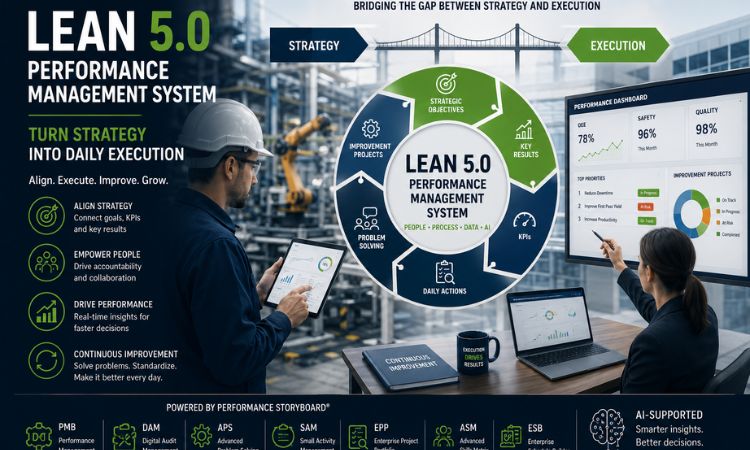
This is where a broader Lean 5.0 Performance Management System becomes valuable.
Within the Performance Storyboard® ecosystem, maintenance management can be connected with KPI management, digital audits, problem solving, projects, competencies and daily operational execution.
This creates a closed-loop management system where deviations are identified, actions are assigned, progress is monitored and results become visible across the entire organization.
Industries That Benefit from CMMS
Maintenance Management Software delivers value across many sectors, including:
- Manufacturing
- Automotive
- Food & Beverage
- Pharmaceuticals
- Logistics & Warehousing
- Energy & Utilities
- Facilities Management
- Healthcare
- Construction
Regardless of industry, the objective remains the same:
Increase reliability, reduce downtime and improve operational performance.
The Future of Maintenance in France
The future of maintenance is increasingly data-driven, connected and intelligent.
Organizations are moving beyond basic preventive maintenance toward:
- Predictive Maintenance
- AI-assisted decision-making
- Connected assets
- Real-time performance monitoring
- Reliability-centered maintenance
- Human-centered Industry 5.0 practices
Companies that invest in modern maintenance systems today are better prepared to improve productivity, strengthen resilience and remain competitive in an increasingly demanding industrial environment.
Smart maintenance is no longer just a maintenance initiative.
It is a business strategy.
Frequently Asked Questions
What is a CMMS?
A CMMS (Computerized Maintenance Management System) is software used to manage assets, maintenance schedules, work orders and maintenance performance data.
How does CMMS reduce downtime?
By enabling preventive and predictive maintenance, CMMS helps identify and address potential failures before they cause equipment breakdowns.
Is CMMS important for TPM?
Yes. A CMMS is one of the most effective tools for supporting the Planned Maintenance pillar of TPM and improving equipment reliability.
What maintenance KPIs should be tracked?
Key indicators include MTBF, MTTR, Preventive Maintenance Compliance, Maintenance Cost per Asset, Planned vs Reactive Maintenance Ratio and OEE.
How does AI improve maintenance management?
AI helps identify anomalies, predict failures, prioritize maintenance activities and support data-driven decision-making.
Is CMMS suitable for small and medium-sized companies?
Yes. Modern CMMS solutions are scalable and can support organizations of all sizes, from small production facilities to global manufacturing enterprises.