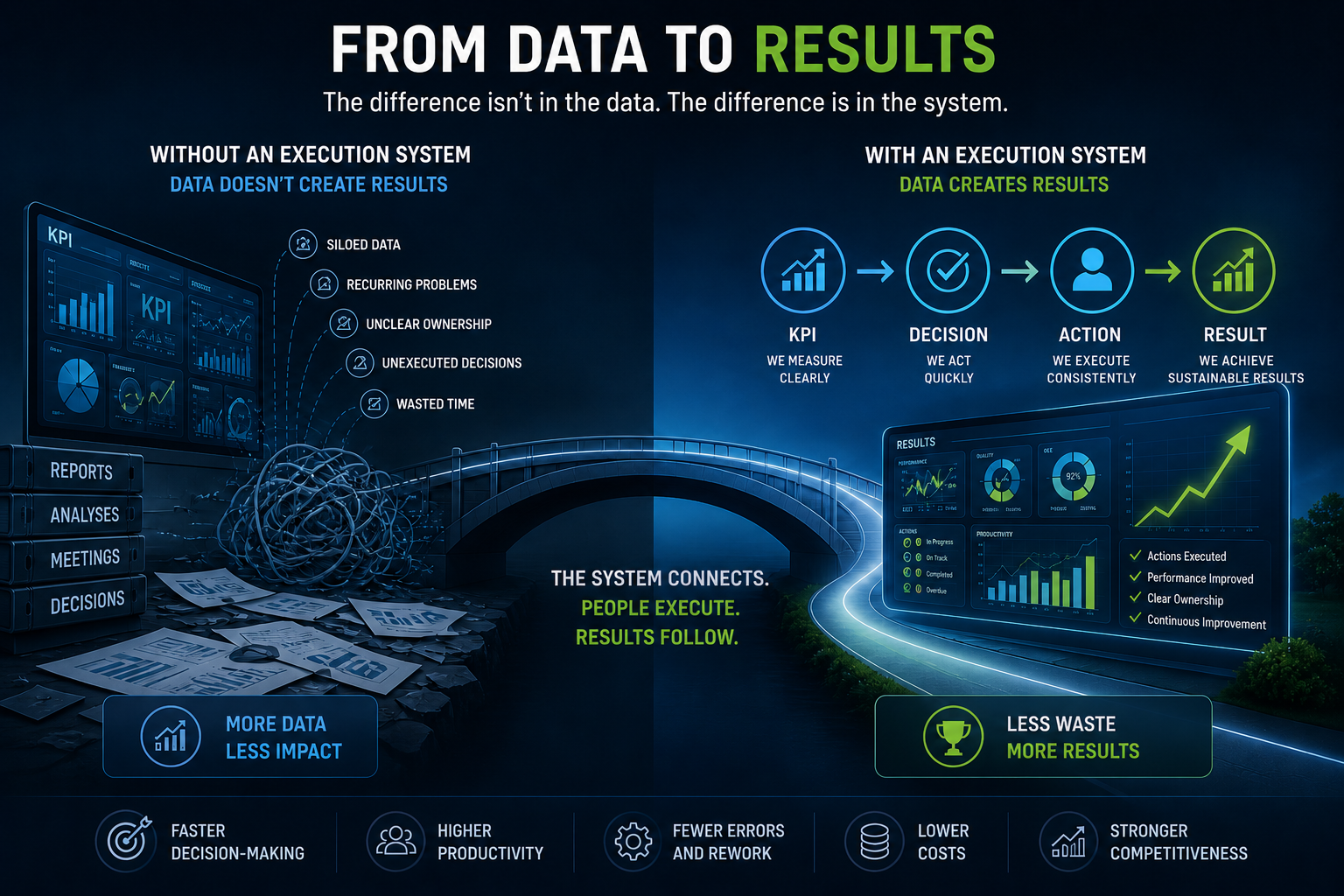
Companies today make decisions based on data. KPI dashboards, BI (business intelligence) systems, reports, and increasingly also artificial intelligence have become standard. Information is available almost in real time, analyses are faster, and visualizations are more advanced. At first glance, we would expect digital tools to significantly improve efficiency.
But in practice, something very different is happening.
Despite the growing volume of data, many companies lose between 5% and 15% of productivity every day due to ineffective digitalization. The problem is not the data itself. The issue is that very few organizations systematically optimize information flows — which digital tools they use, how these tools are connected, and most importantly, how people actually use them in practice.
More data therefore does not automatically mean better results.
In many organizations, the amount of analysis continues to increase, the number of decisions grows, yet the actual impact on business results remains limited. Not because the decisions are wrong, but because the system that ensures disciplined execution is often missing.
The key problem is the lack of continuous improvement in digitalization itself.
Companies often optimize production processes, logistics, and costs, but pay far less attention to how information flows, how decisions are made, and how execution actually happens. Digital tools, dashboards, and artificial intelligence do not create value on their own. Value is created only when decisions are effectively transformed into concrete actions and measurable results.
This is one of the largest — yet at the same time one of the least visible — losses in modern organizations today.
The Hidden Losses of Digitalization
When a company selects the wrong digital tools or uses them without a clear system, hidden losses begin to emerge — losses that are rarely measured and therefore rarely managed.
The root cause is not only the choice of tools, but the fact that companies do not systematically manage the way those tools are used.
The use of digital tools and the flow of information should never be left to chance. They require the same level of discipline as production or logistics processes. Without this discipline, even the best tools fail to deliver the expected results.
This is why digitalization must be managed in a structured way:
how tools are used in practice, how information flows across the organization, and how effectively those flows support decision-making and execution.
Only then do digital tools become part of an operational system — not just a source of data.
Employees spend valuable time preparing analyses that never translate into concrete actions. Problems keep recurring because decisions are either not implemented or their impact is never verified. Departments operate in silos, even though everyone is looking at the same data.
An illusion of control is created because the numbers are visible, while in reality there is no real control over execution.
These are not isolated cases.
This is the daily reality in many companies.
What Does It Actually Cost?
If we look more broadly, various studies and practical experiences show that between 70% and 90% of company strategies fail during execution. Not because the strategies are wrong, but because execution is insufficient.
At the same time, employees often spend between 20% and 30% of their working time on low-value-added activities caused by unclear processes and inadequate digital support.
In manufacturing environments, this can mean daily productivity losses of 5% to 15%. Financially, this represents thousands of euros per day — or well over one million euros annually in a medium-sized company.
And this happens without a single major failure.
It is the cumulative effect of small inefficiencies that the system simply does not detect.
Why Digital Tools Often Fail to Deliver Results
Most digital solutions are designed primarily to support reporting. They provide visibility into data, trend analysis, and deviation detection. This is an important step — but it is not enough.
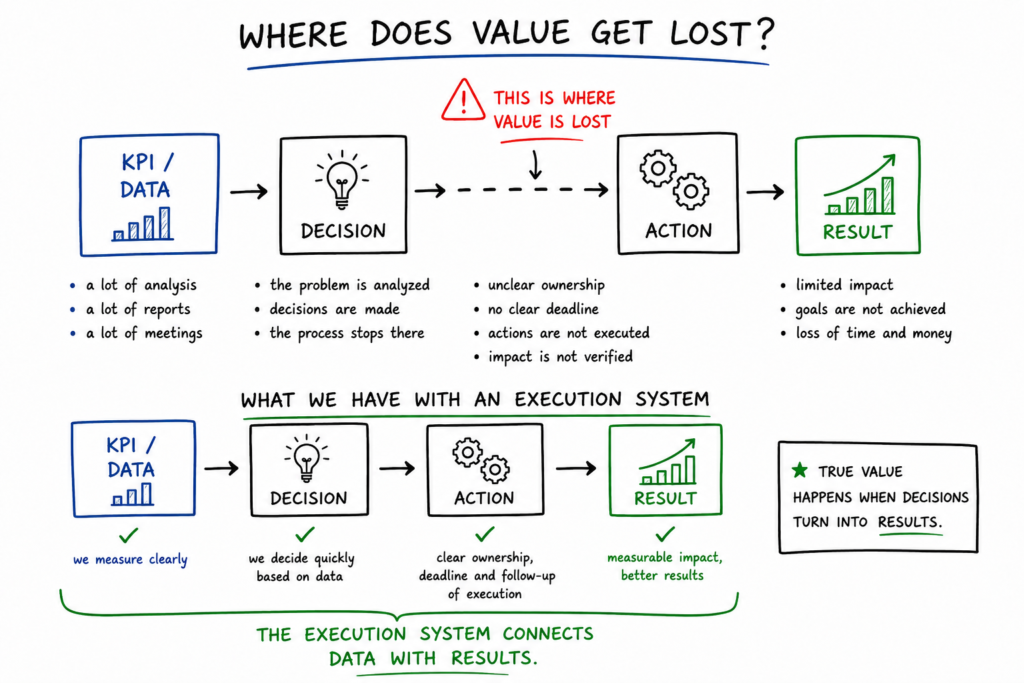
When a KPI shows a deviation, the typical process inside companies looks like this:
the problem is analyzed, a decision is made during a meeting, and then the process often stops there.
What is missing is the execution structure:
- action
- ownership
- deadline
- verification of effectiveness
Without these elements, the digital tool remains only an information system.
It never becomes a true management system.
Efficiency Is Not About the Tool — It’s About the System
The real value of digitalization appears only when a system exists that connects data with execution.
When there is a clear connection between:
- KPI
- actions
- results
When ownership is defined and execution is monitored with the same discipline as measurement itself.
In such an environment, digital tools become an active part of operational management. They enable organizations not only to detect deviations, but to systematically eliminate them.
This is when digitalization starts to truly influence:
- productivity
- quality
- costs
Conclusion
Today, companies do not lose performance because of a lack of data. They lose it in the space between decision and execution.
Most organizations already have enough KPIs, analyses, and meetings. The real difference lies in whether they have an execution system in place.
When digitalization supports execution, it begins to create real value. Data becomes the foundation for focused action — not just for understanding the current situation.
The real impact happens when organizations establish a clear connection:
KPI → decision → action → result
This is not primarily a technology challenge.
It is an operational management system challenge — connecting people, processes, and decisions into daily practice.
Companies that understand this do not stay at the level of analysis.
They execute systematically — and therefore achieve results.