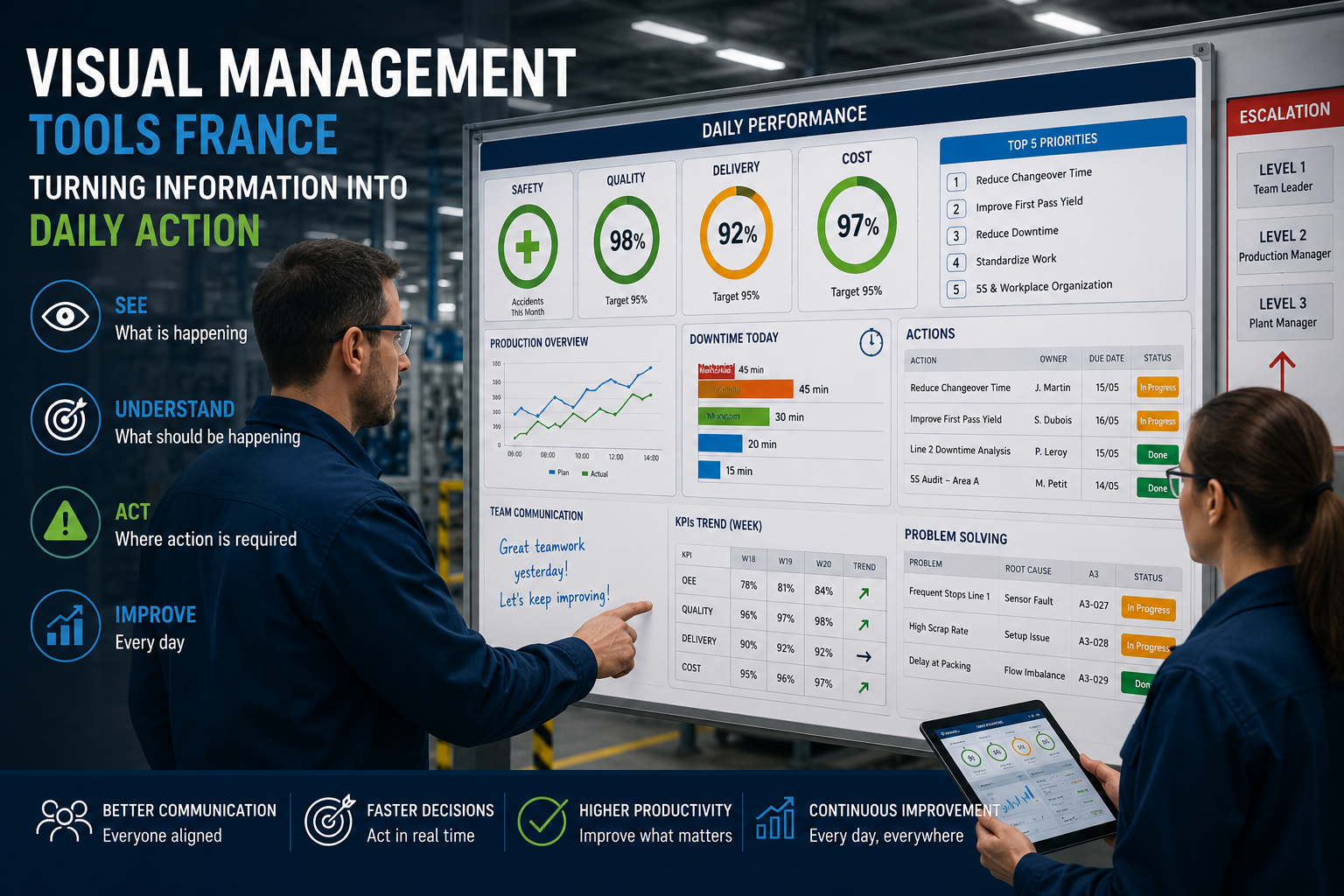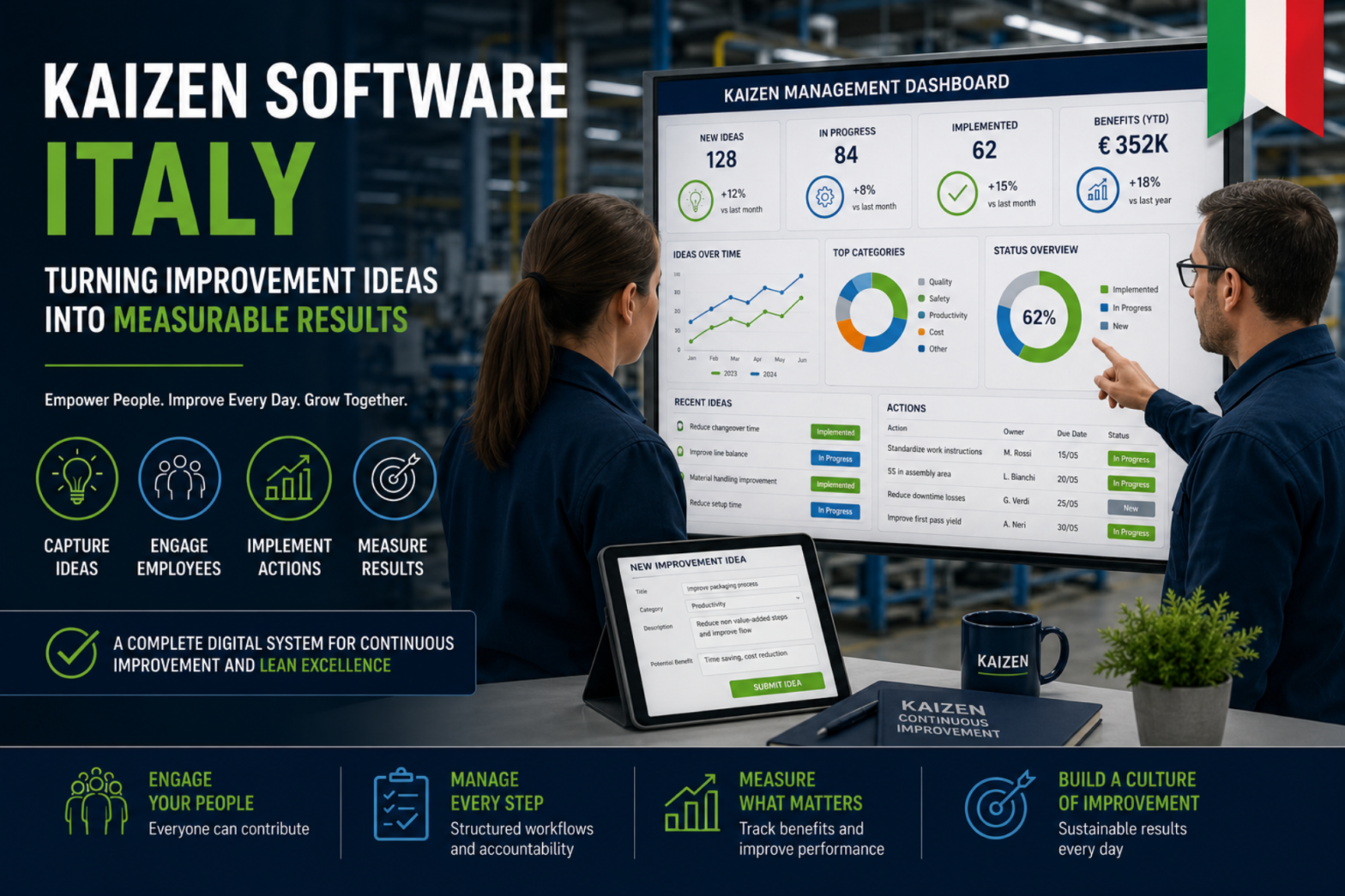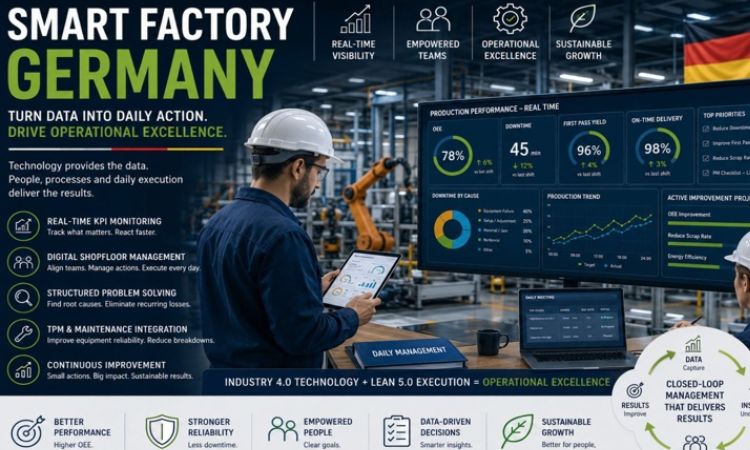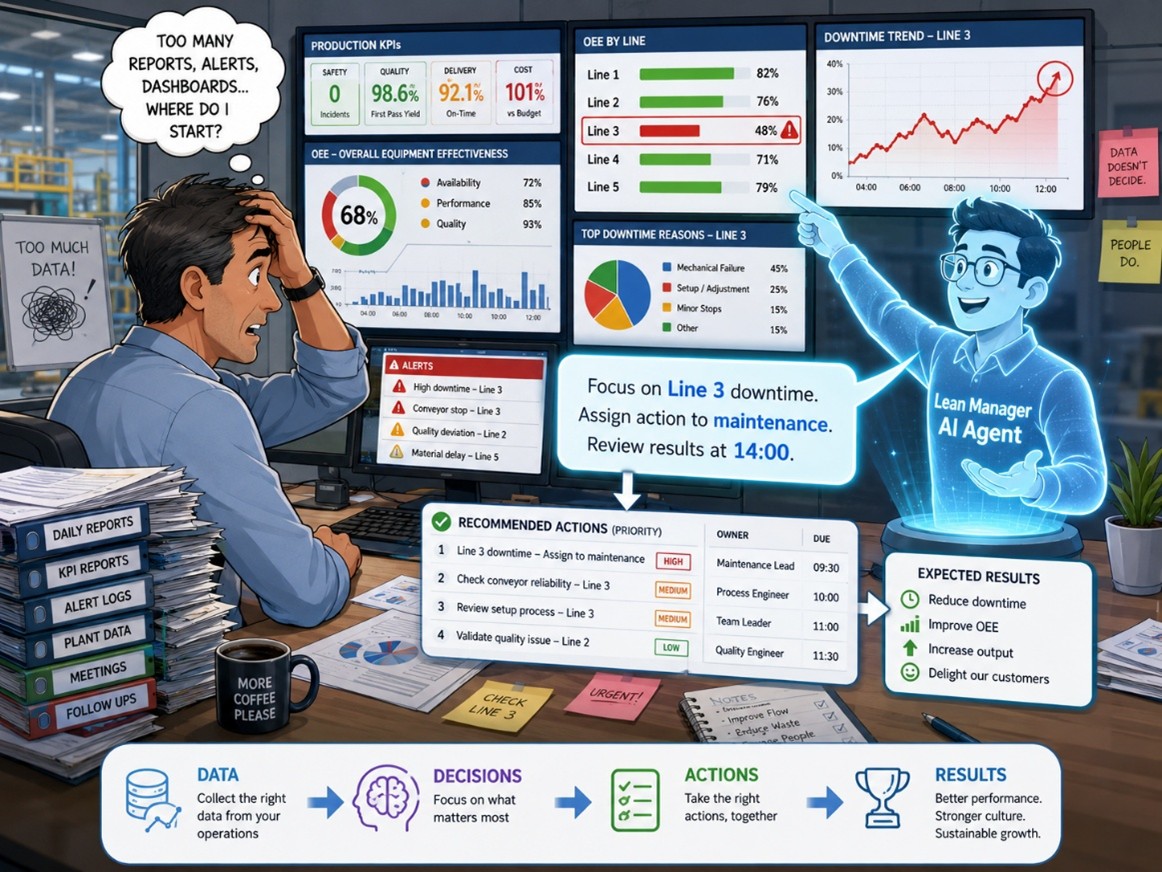
A few years ago, managers in manufacturing companies often talked about a lack of data.
Today, they talk much more about a lack of time, focus, and clarity.
This is one of the biggest paradoxes of modern digitalization. Companies have more data than ever before, but people in leadership and operational management roles are often more overloaded than ever before.
A production manager starts the morning by opening several dashboards. OEE, quality, delivery performance, open actions, workforce availability, machine downtime, customer complaints, project status. Before the first review is even finished, Teams messages arrive, a production line stops, quality raises an escalation, and someone asks for a decision on priorities.
A shift leader is standing between the shopfloor board, an Excel file, the MES system and several open tasks from yesterday’s meeting. The data exists. The reports exist. The alerts exist. But the real question remains: what should be done first, who should do it, and how do we make sure it actually happens?
A maintenance manager can see downtime trends, failure data, preventive maintenance plans and spare parts status. But the system does not always help enough with the most important management questions: what is critical now, what is the expected impact, who must act, and how will we follow up the result?
And this is where the real problem starts.
Many companies are investing heavily in BI systems, MES platforms, predictive analytics, AI pilots, automation, IoT and digital dashboards. On the surface, manufacturing is becoming more digital, more connected and more data-driven.
But in practice, digitalization often brings more screens, more reports, more alerts, more meetings and more complexity for the people who are expected to lead.
McKinsey’s latest manufacturing COO study confirms exactly this challenge. Most companies are no longer struggling with access to data or AI technologies. The real challenge is scaling execution — turning data and insights into consistent operational impact.
The biggest gap still exists between:
Data → Decisions → Actions → Results
Most organizations already have systems for monitoring data.
Far fewer have a clearly defined digital management system.
A system where KPIs trigger actions.
Where deviations lead to structured problem-solving.
Where responsibilities are clear.
Where cross-functional teams work on the right priorities.
Where follow-up is systematic.
And where digitalization reduces complexity instead of increasing it.
This is why the next step in industrial digitalization is not just another dashboard or another AI pilot.
The next step is a closed-loop performance management system.
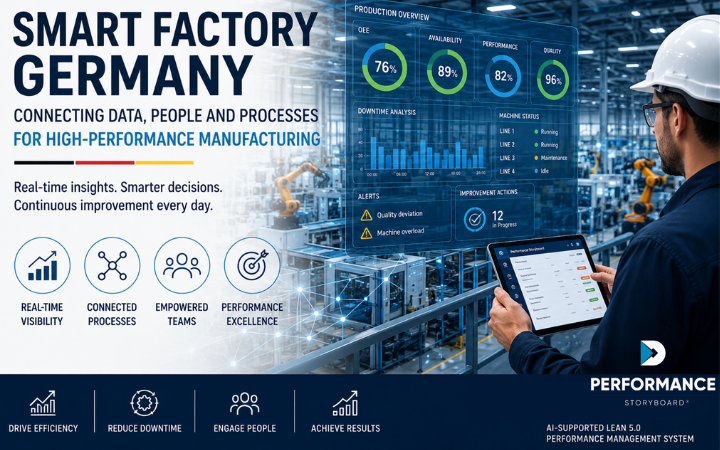
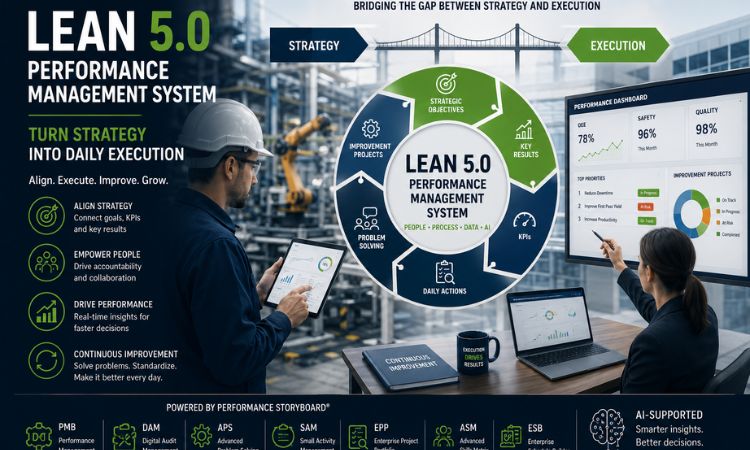
This is also the idea behind PERFORMANCE STORYBOARD® – Lean 5.0 Performance Management System.
Performance Storyboard is a modular Lean Management System that connects strategy, KPIs, daily management, TPM routines, audits, structured problem-solving, and people development into one integrated digital framework.
It connects data, KPIs, deviations, decisions, actions, responsibilities, structured problem-solving, TPM, audits, competencies and results into one integrated management system.
The goal is no longer only to see the data.
The goal is to help people lead better.
Because the future will not belong to companies with the most data or the most AI tools. It will belong to organizations that know how to connect people, processes, digitalization and AI into one scalable execution system.
A system capable of consistently transforming:
Data → Decisions → Actions → Results
And maybe the real question for the future is very simple:
How valuable would it be if every manager had an AI-supported assistant for leadership and execution?