November 12, 2026
Why do the same problems keep returning, even after teams have analysed them and implemented corrective actions?
Manufacturing companies regularly deal with quality issues, equipment failures, production interruptions and customer complaints. Most are familiar with structured problem-solving methods such as 5 Why, Ishikawa, A3, 8D and PDCA. Yet recurring problems remain a common challenge.
The difficulty is often not a lack of methods, but how consistently teams apply them. Poor problem definitions, unverified assumptions, weak root cause analysis and insufficient follow-up can undermine even a well-established problem-solving process.
Based on our experience working with manufacturing organisations, these are nine mistakes worth examining.
1. Starting with a poorly defined problem
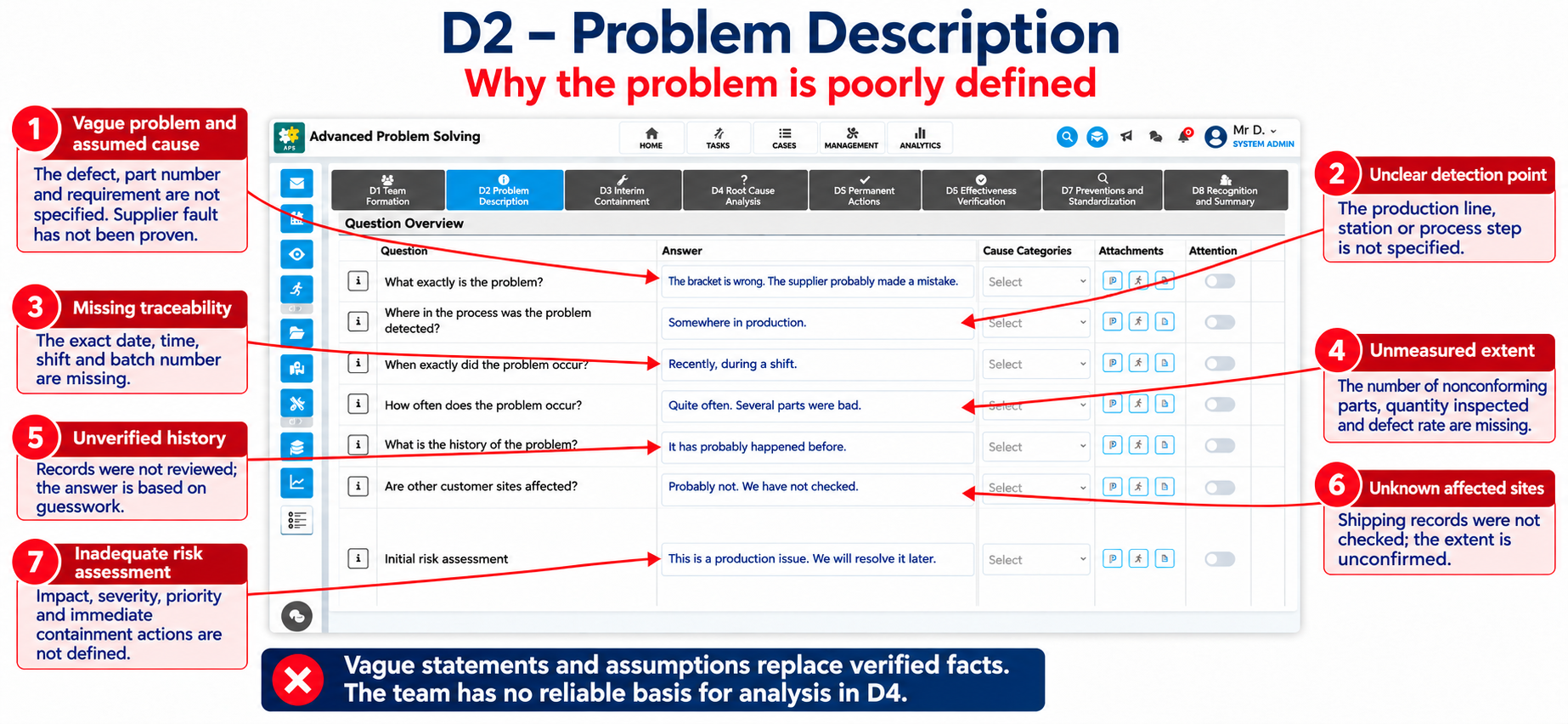
“We have quality issues with brackets” does not provide enough information for a meaningful investigation. What exactly is wrong? Where and when was the defect detected? How frequently does it occur, and what requirement has not been met?
Consider the difference:
Poor description: “The bracket is wrong. The supplier probably made a mistake.”
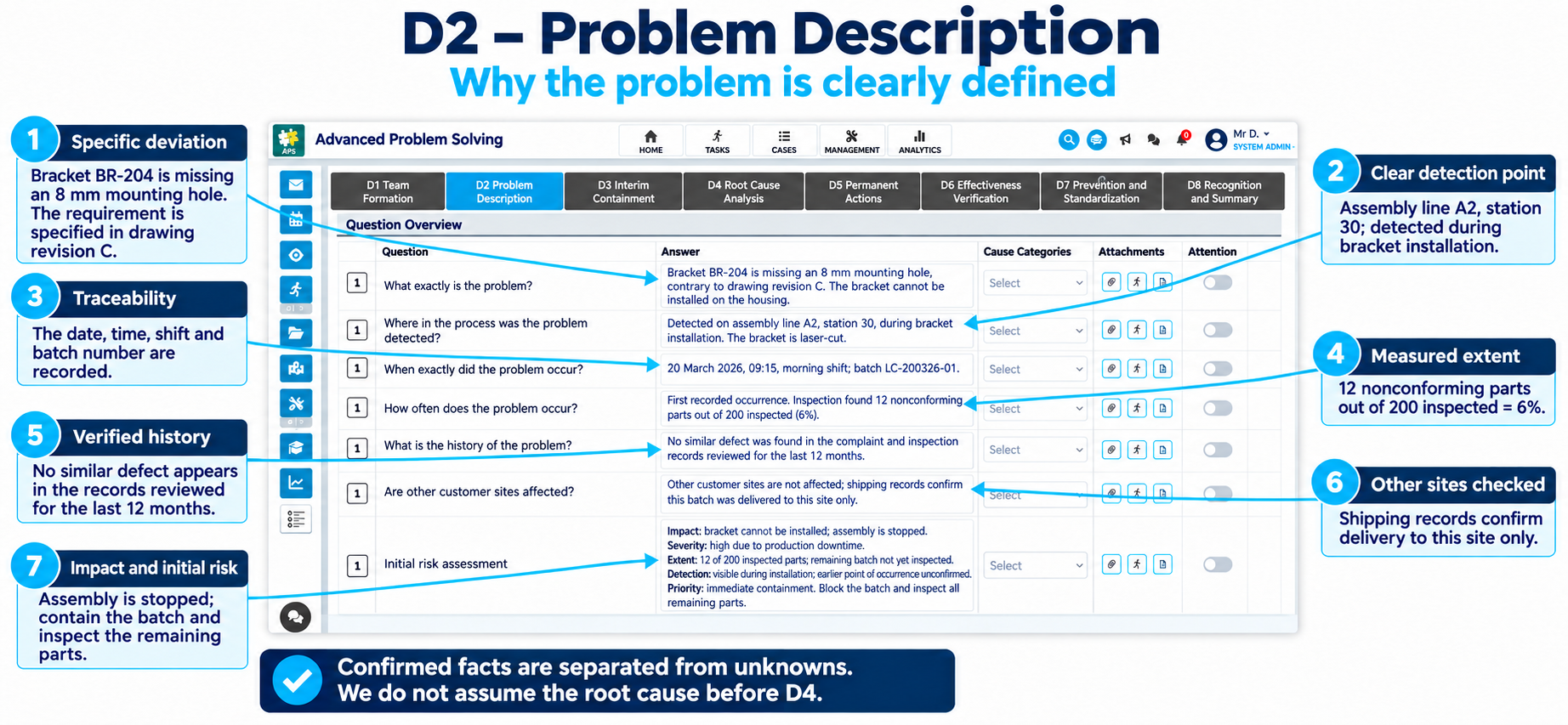
Good description: “An 8 mm mounting hole is missing from bracket BR-204, contrary to drawing Rev. C. The defect was detected at assembly line A2, station 30. Inspection identified 12 defective brackets among 200 inspected parts.”
The second description establishes a measurable deviation without assuming its cause. A reliable investigation starts with facts, not interpretations.
2. Solving problems without going to the Gemba
Reports, KPIs and meetings provide useful information, but they cannot always explain what happened where the problem occurred.
Effective problem-solving requires direct observation of the process, examination of affected parts and equipment, and conversations with the people involved.
Go & See remains essential. Decisions based only on reports or recollections can easily lead teams towards incorrect conclusions.
3. Confusing assumptions with facts
“The material was probably unsuitable” is a hypothesis, not a confirmed cause. The same applies to statements such as “The operator was not properly trained.”
Hypotheses help guide an investigation, but they must be verified through observations, measurements, records or testing.
Before accepting a conclusion, ask: What evidence supports it, and how have we verified it?
4. Accepting vague explanations
“Human error”, “poor communication” and “lack of training” may describe a contributing factor, but they rarely explain precisely how a problem occurred.
If an operator made an error, we need to understand what happened differently from the standard. Was the instruction clear? Were the correct tools available? Could the error have been prevented or detected?
Effective corrective actions depend on specific, evidence-based findings, not general explanations.
5. Applying 5 Why mechanically
The purpose of 5 Why analysis is not to produce exactly five answers. It is to establish a logical cause-and-effect chain supported by evidence.
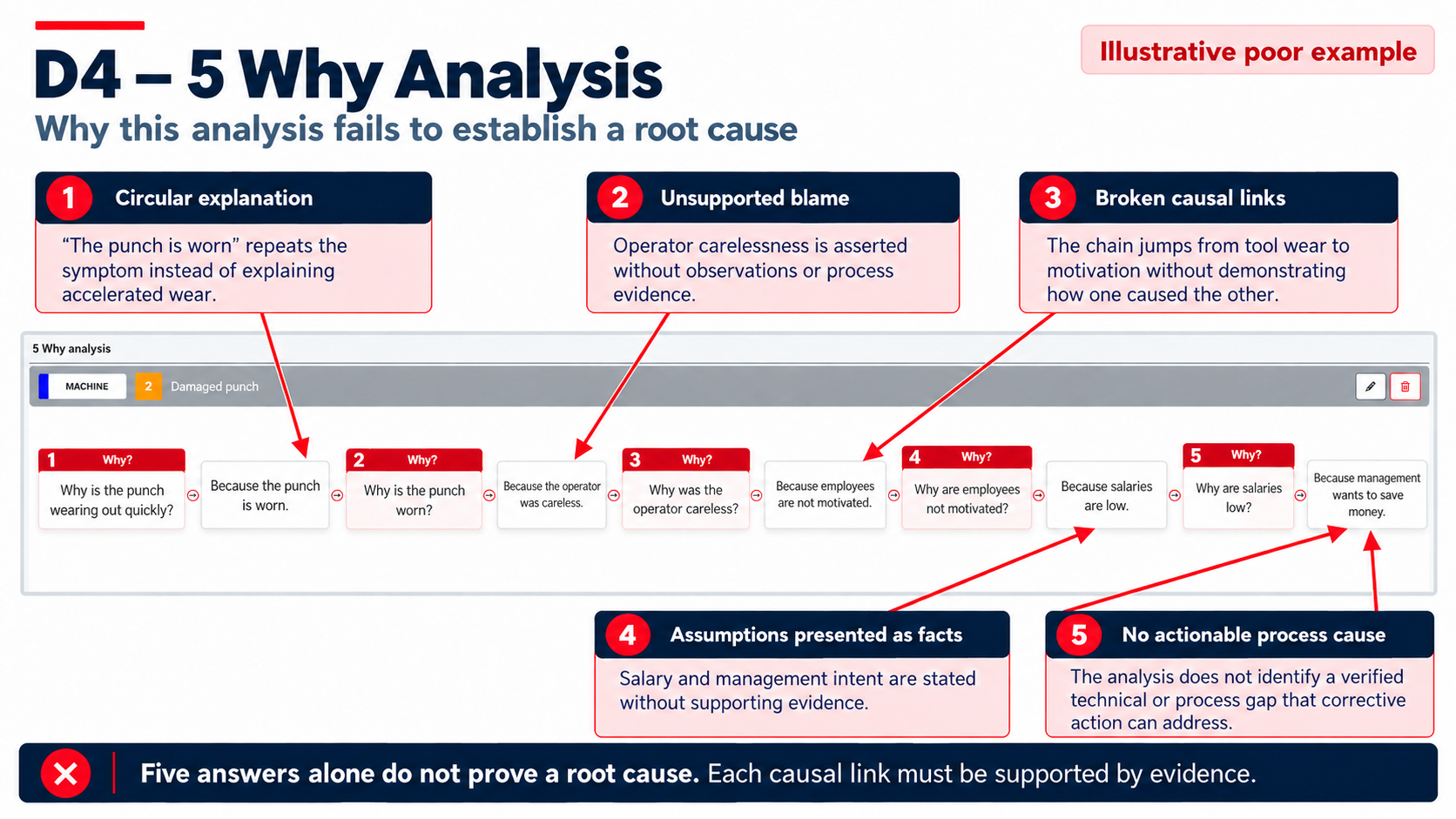
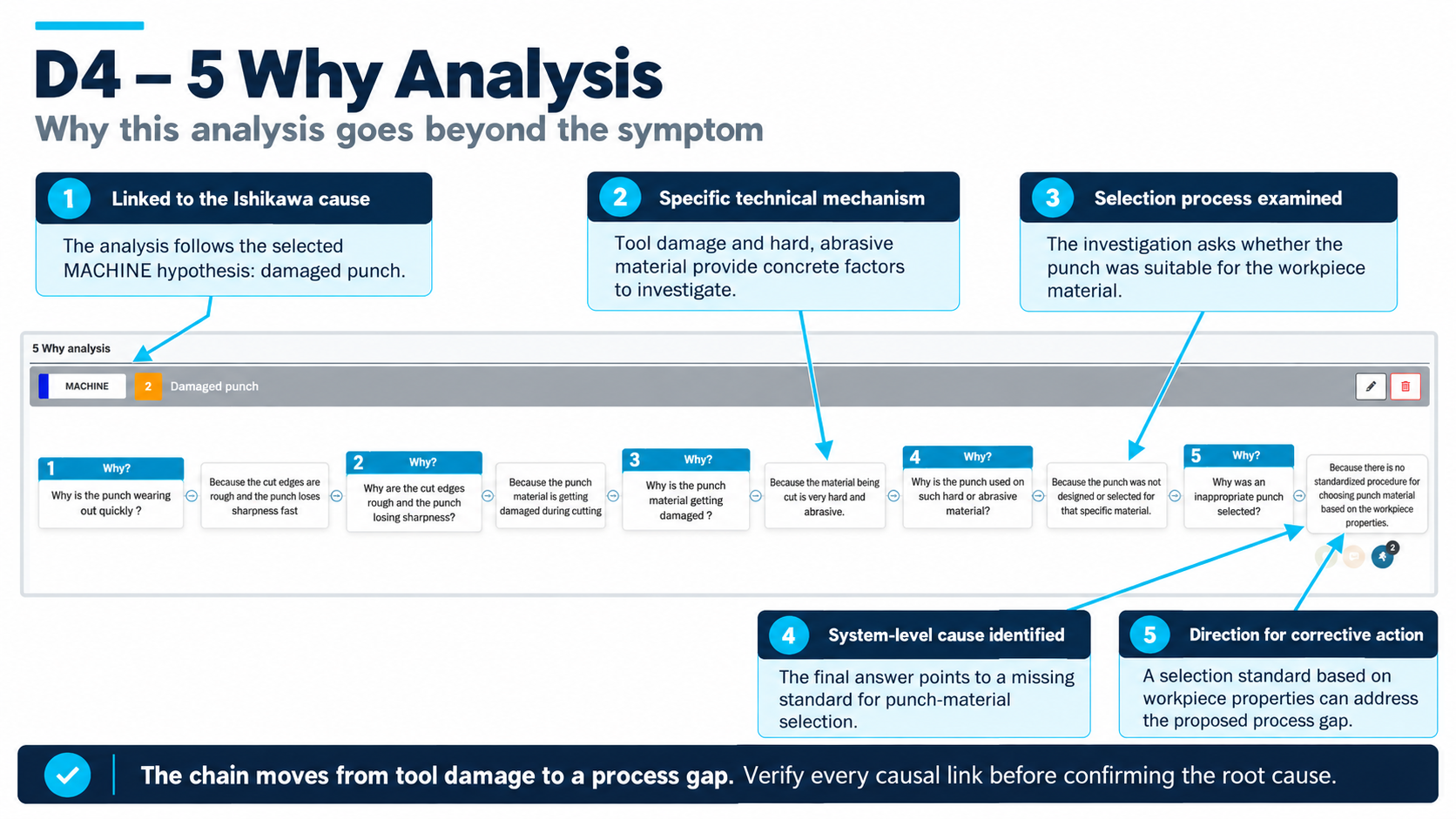
Consider a punch that wears out prematurely. A weak analysis may blame operator carelessness or employee motivation without verifying either claim.
A stronger investigation examines the wear mechanism, workpiece material, tooling suitability and the process used to select the punch. If the evidence confirms a mismatch, the team can investigate whether the tooling selection standard is adequate.
This moves the analysis beyond the technical symptom towards a potentially correctable process weakness.
Five answers alone do not prove a root cause. Every causal link must be verified.
When a problem occurs, immediate containment may be necessary to protect customers or restore production. However, containment is not the same as a permanent corrective action.
Replacing a damaged component may solve the immediate issue without preventing recurrence.
Before implementing a permanent solution, teams should establish which verified cause the action addresses and why it is expected to work.
7. Fixing technical failures without improving the process
Replacing a tool, adjusting a sensor or repairing equipment may be necessary. But why did the process allow the failure to occur or remain undetected?
Depending on the findings, lasting improvement may require changes to work standards, preventive maintenance, process controls or escalation procedures.
The objective is not simply to restore normal operation, but to reduce the likelihood of the same failure recurring.
8. Running unstructured problem-solving meetings
Even experienced teams can lose direction when discussions jump from symptoms to solutions before the facts are established.
Effective facilitation keeps the investigation focused, separates assumptions from evidence and ensures clear ownership of actions.
Methods such as A3, 8D and PDCA provide structure, but their value depends on disciplined execution.
Completing a problem-solving template is not the same as conducting a quality investigation.
9. Closing problems before verifying effectiveness
A corrective action has been implemented, responsibilities are documented and the report is closed. But has the problem actually been solved?
Teams need to verify whether the action delivered the expected result and whether the problem recurs under comparable conditions.
Successful improvements should also be reflected in relevant work standards, control plans, maintenance procedures and Lessons Learned.
An implemented action is not necessarily an effective action.
How APS Supports Better Problem-Solving
These nine mistakes share a common characteristic: they are often caused by inconsistent execution rather than a lack of methodology.
APS – Advanced Problem Solving, a module of the Performance Storyboard® platform, supports teams throughout the structured problem-solving process, from problem definition and evidence collection to root cause analysis, corrective actions and effectiveness verification.
Using methods such as 8D, A3, PDCA and 5 Why, APS helps maintain a consistent approach and clear traceability between findings, causes and actions. AI-assisted functionality can suggest additional questions and highlight potential gaps or unsupported assumptions in the analysis.
However, digitalisation cannot replace direct observation, technical knowledge or professional judgement. Its role is to support a more disciplined and transparent investigation.
The goal is not simply to close problems faster, but to solve them more effectively and prevent recurrence.
APS does not solve problems for people. It helps people solve problems better.