“Let’s develop it ourselves — we know our processes best.”
This idea is becoming increasingly common. Tools are more accessible, artificial intelligence is accelerating development, and the sense of control is strong. At first glance, the decision seems logical. Companies want systems that fully reflect how they work, without the compromises that often come with standard solutions.
In practice, however, this decision quickly opens a much broader question than it appears at the beginning.
Where the Gap Between Idea and Reality Begins
Development usually starts with a clear and justified purpose. A company builds one application to solve a real problem, then another, and then a third. Each solution delivers value on its own.
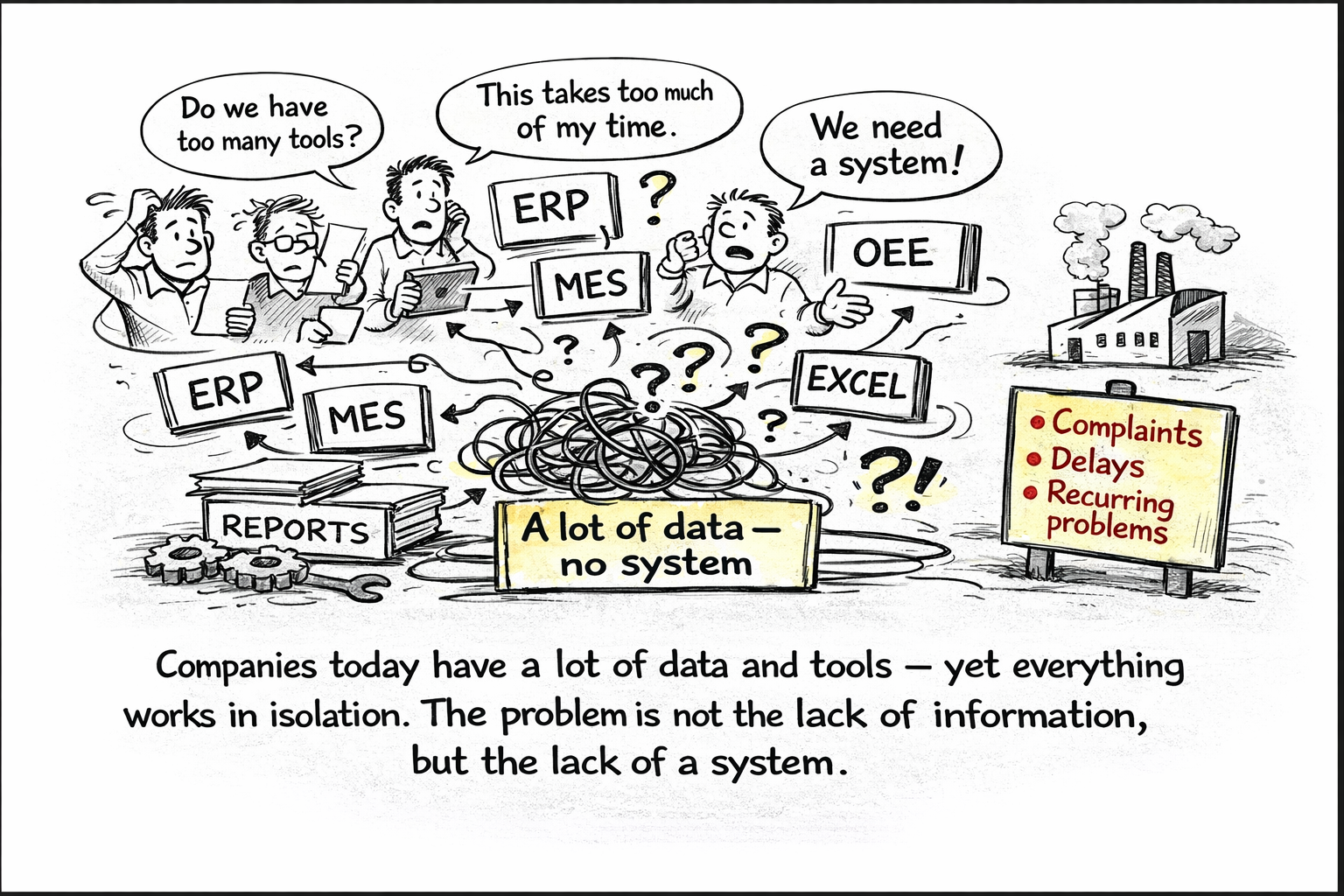
Over time, however, a familiar pattern emerges: a landscape of tools that function well individually, but do not form a coherent system together.
At that point, the questions are no longer technical:
- Why is there still limited visibility despite all the tools?
- Why do decisions still require extensive coordination?
- Why do the same problems keep returning?
The answer is typically the same: digitalization was not designed as a system.
Complexity is rarely created by a lack of tools — but by a lack of structure.
Digitalization Without a Concept: A House Without an Architect
This situation can be clearly illustrated with a simple analogy.
When building a house, you can select high-quality elements — a modern kitchen, industrial lighting, classic furniture. Each component works. Each adds value.
But without a unified concept, the result lacks coherence.
The house stands, but it does not function as a logical whole.
The same applies to manufacturing companies. Systems such as ERP, MES, BI, and internally developed applications all fulfill their role. However, without a clear architecture, they do not create a system that supports the way the company actually operates.
What emerges instead is predictable:
- instead of flow → complexity
- instead of clarity → coordination
- instead of speed → delays
Digital chaos is still chaos — just faster.
Software Always Reflects the Way You Work
One principle consistently proves true in practice:
software does not define the way a company works — it reflects it.
Where processes are clear, responsibilities understood, and decision-making structured, digital tools strengthen the system.
Where this is not the case, they simply digitize existing inefficiencies.
This leads to a critical shift in thinking.
The real question is not which tool to build or buy.
The real question is whether the company has a clear management concept that connects goals, data, and daily work.
Technology scales what already exists — clarity or confusion.
Development as a Reflection on How You Work
Internal development has real value — but not always for the reasons companies expect.
It forces the organization to think more deeply about:
- how work actually flows
- where deviations occur
- how decisions are made
These questions are no longer abstract. They must be translated into a functioning system.
The value of development therefore lies not only in the final software, but also in the clarity it creates along the way.
Good software is not built from code first — it is built from understanding.
Lean Perspective: From Digital Tools to a Lean Management System
The Lean approach is very clear: first define the way of working, and only then support it digitally.
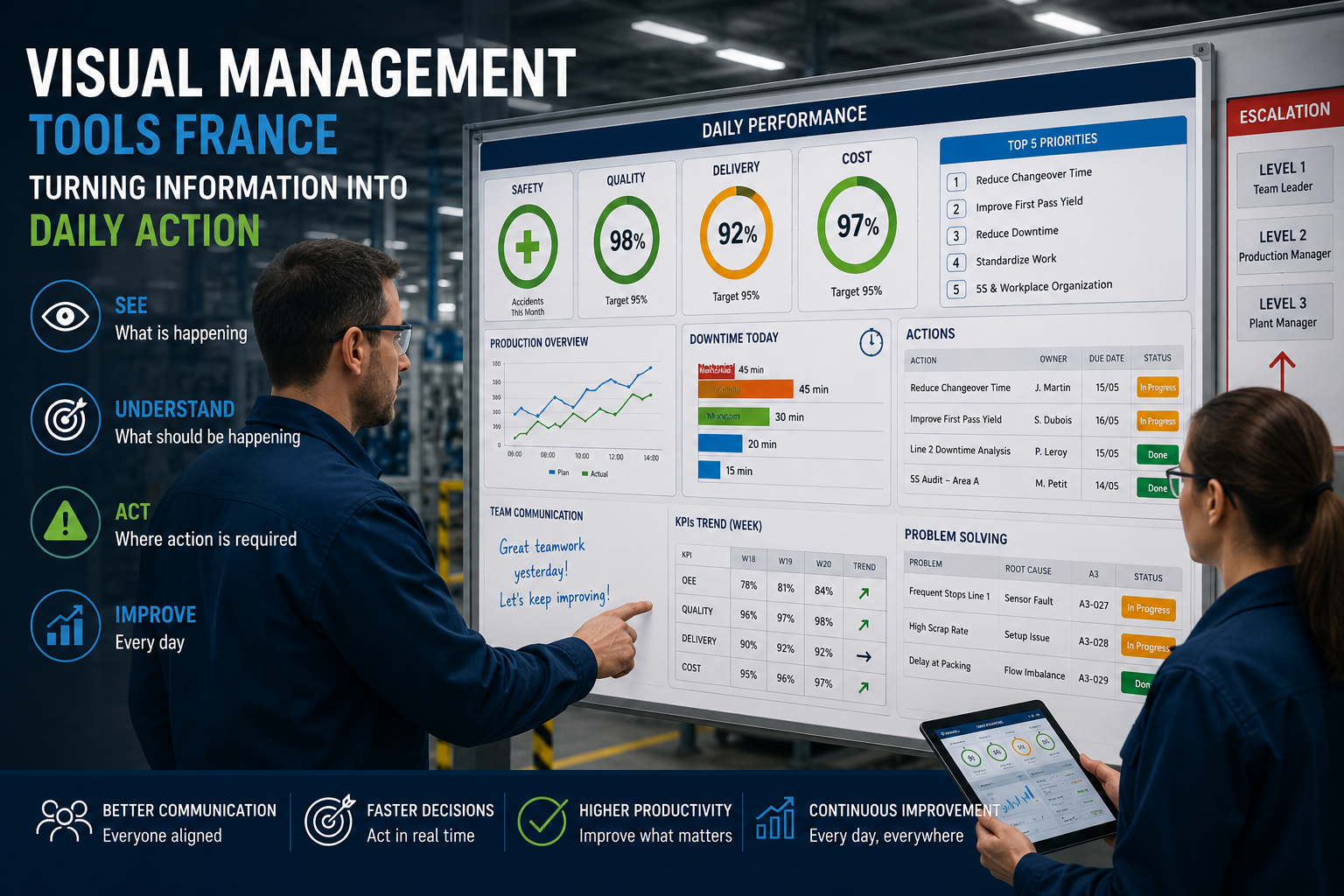
When a company clearly defines how it manages processes, solves problems, and makes decisions, digitalization becomes an accelerator. Performance indicators gain operational meaning, deviations trigger action, and daily work follows a structured rhythm.
At this stage, digitalization becomes something more.
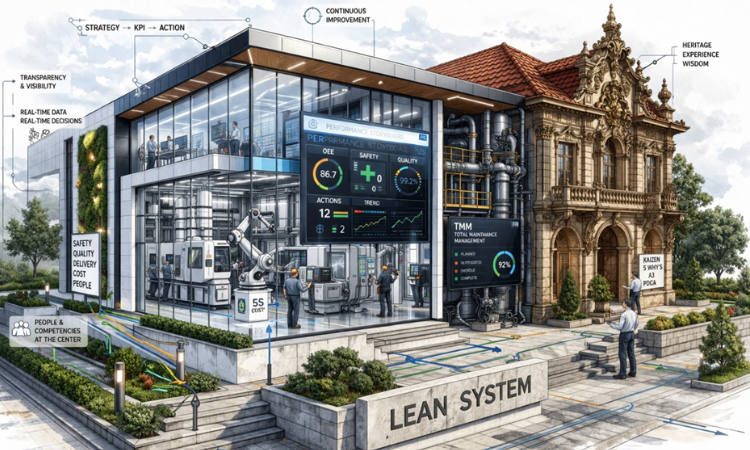
It becomes a LEAN MANAGEMENT SYSTEM — a system that connects strategy, KPIs, and execution into one coherent whole.
Without a system, improvement remains an initiative. With a system, it becomes a routine.
A System Approach in Practice: Performance Storyboard®
This is precisely why solutions such as Performance Storyboard® are not defined by individual functionalities, but by the system they represent.
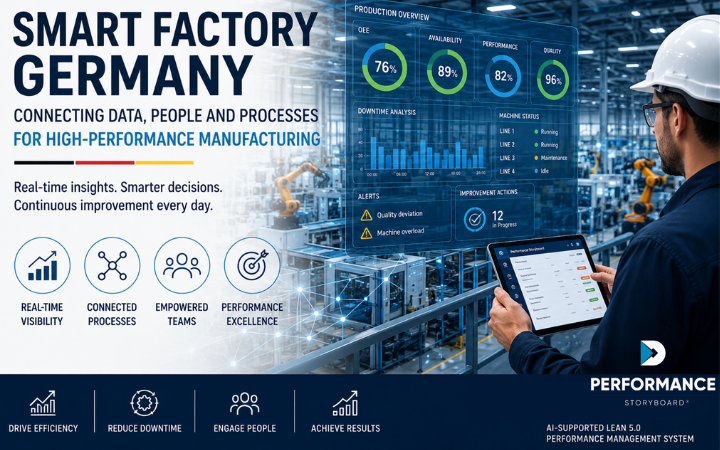
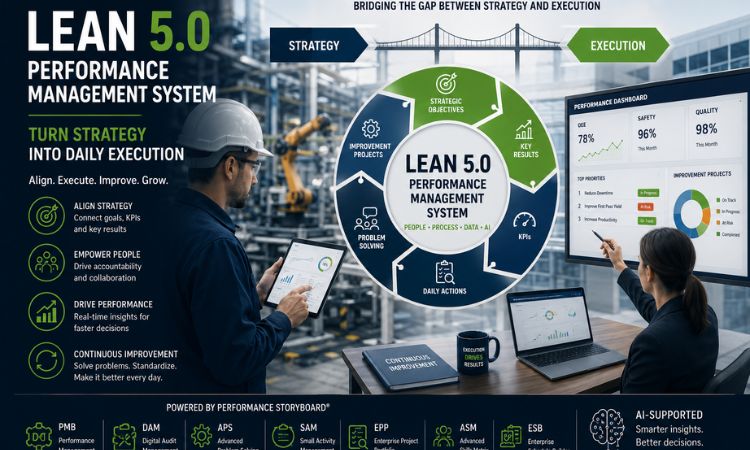
Performance Storyboard is a modular Lean Management System that connects strategy, KPIs, daily management, TPM routines, audits, structured problem-solving, and people development into one integrated digital framework.
Instead of disconnected tools, the system establishes a clear operating logic:
- KPIs trigger concrete actions
- actions address root causes
- results are measurable within the same system
This creates what most companies struggle to achieve on their own: a closed-loop management system.
Not just monitoring performance — but actively managing it.
Performance does not improve because it is measured. It improves because it is managed.
When Internal Development Creates the Most Value
Internal development creates the greatest value where the company is truly unique.
For example:
- its way of planning
- its approach to optimization
- its method of managing production
In these areas, software becomes part of the company’s know-how and directly supports its competitive advantage.
In other areas, companies benefit more from:
- proven systems
- structured frameworks
- established management logic
The most effective approach is rarely extreme. It is a combination.
Conclusion
Digitalization in manufacturing is not primarily a question of whether to build or buy software.
The key question is much simpler:
Does the company have a unified management concept that connects strategy, KPIs, and daily execution?
If not, even the most customized applications will not create clarity.
They will create digital complexity.
Final Thought
The difference between successful and unsuccessful digital projects is not technology.
It is whether a company builds:
- a system
- or just tools
We don’t build software. We build a LEAN MANAGEMENT SYSTEM.
The real competitive advantage is not in the tools a company uses, but in the way it uses them.
In the end, the same principles always make the biggest difference:
- clear processes
- disciplined execution
- ability to learn and improve
Progress does not come from code.
It comes from the way a company thinks, decides, and acts.