Advanced Problem Solving in manufacturing never appear by accident; there is always a cause behind them. The real question is how companies go about finding that cause. Some begin by looking at data, observing the process, measuring, and making sure they understand what is truly happening. Others rely on opinions, experience, or intuition.
It feels faster – but it is far riskier.
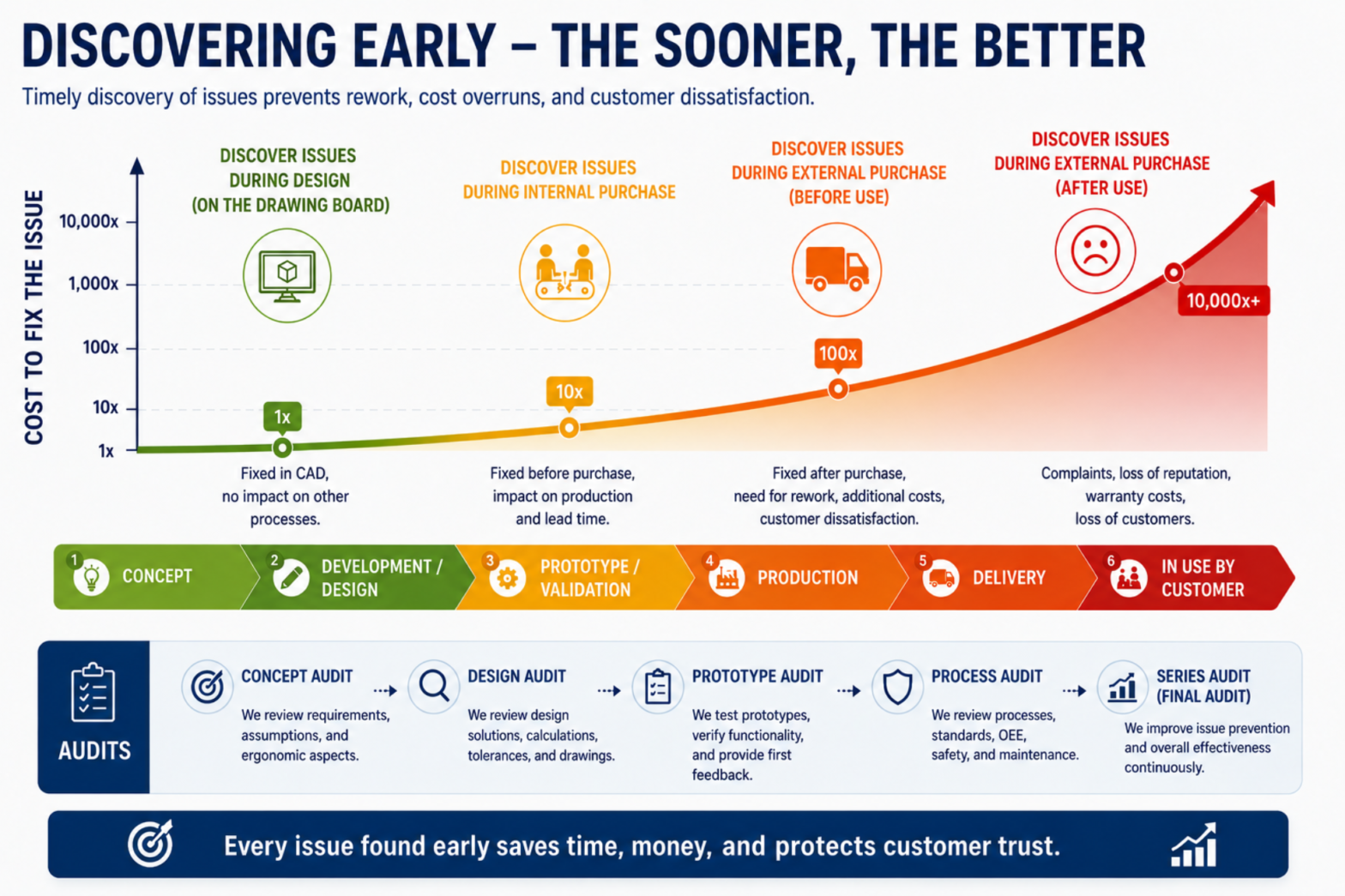
Decisions made on opinions are the number one reason why problems keep coming back. And with every recurrence, the costs quietly grow: extra hours, repeated defects, customer complaints, trial-and-error adjustments, firefighting activities, lower efficiency, and disrupted production flow.
Many companies discover, when they look back, that a significant share of these costs was completely unnecessary. A correct root cause analysis at the beginning would have prevented them entirely.
Getting to the Real Root Cause
The most effective teams start where the Advanced Problem Solving actually occurs; in the process. They observe the work, collect measurements, review data, document what they see, and talk to the operators who perform the tasks. They don’t rely on second-hand interpretations. They verify the facts themselves.
Just as important: they document every step of the process. Not for bureaucracy, but to understand the reasoning behind decisions and to create repeatability. This is how organizational knowledge grows. Every resolved problem becomes a reference for the next one.
The Role of Methods and Tools
Tools like A3, 8D, Ishikawa diagrams, 5 Whys, and PDCA are widely used for structured Advanced Problem Solving. They are powerful, but only when they are driven by facts.
The challenge arises when teams use these tools only formally – as templates to be filled in – instead of as thinking frameworks. The result is predictable: the problem returns, because assumptions replaced evidence.
How to Overcome This?
Companies need a guided, structured approach that leads teams through the reasoning process, ensures critical steps are not skipped, and connects data into a clear cause-and-effect chain. This is exactly what Advanced Problem Solving (APS) provides – a digital solution that standardizes the problem-solving process and eliminates the biggest risk: decisions made without facts.
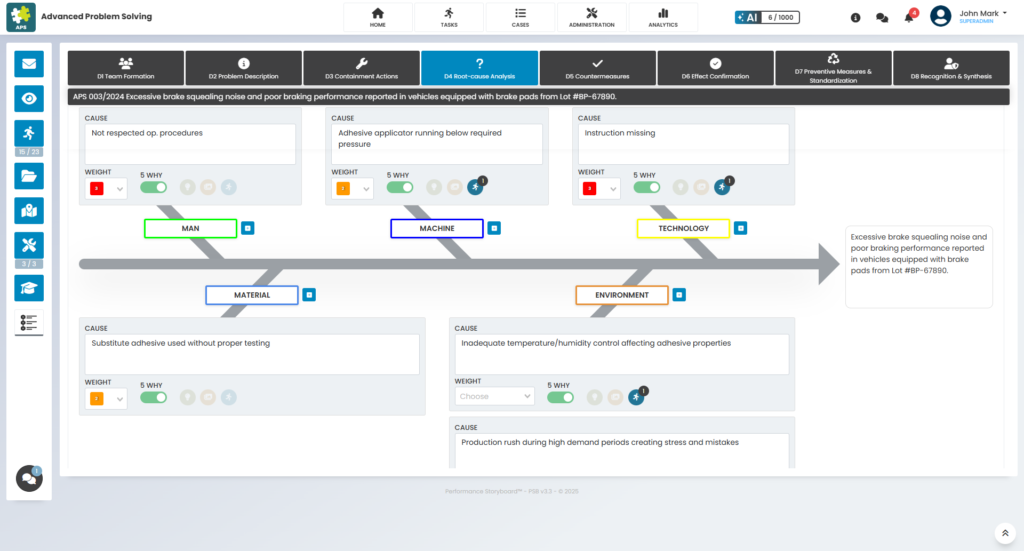
With APS, the entire Advanced Problem Solving becomes traceable, fact-driven, and visually understandable. This reduces ambiguity, eliminates hidden assumptions, and helps organizations avoid common pitfalls that lead to recurring problems.
Organizations using APS achieve more than 20% faster problem resolution and significantly more robust, stable solutions. APS prevents superficial analyses, improves cross-functional communication, and ensures that documentation, evidence, photos, measurements, and conclusions remain organized, traceable, and available to everyone involved.
A Proven Example: DS Smith
APS is not “just another tool on the shelf.” Its value is obvious in many companies – including the example we shared at this year’s Lean Academy.
DS Smith received the Lean 4.0 Award because they implemented APS across their factories worldwide and created a consistent, highly effective way of solving problems.
Why did they choose APS?
Because it helped them cut analysis time, reduce recurring issues, and make faster, better decisions. When teams work with a clear, structured, fact-based process, problems don’t return – they get solved at the root.
What’s great is that we’re seeing similar results in Slovenia as well.
More and more companies use APS daily, and the improvements are very real. Some strong examples include:
Polycom d.o.o., where APS has become an important part of their improvement system. It gives teams a clearer view of what is really happening in the process and helps them reach the right solutions faster.
CFLEX, where APS significantly improved traceability, analytics, and the speed of solving complex technical issues.
And these are just a few – many companies are discovering that a structured, visual, data-driven approach simply works better.
All these stories show the same thing:
when decisions are based on facts, not opinions, the quality of problem solving improves dramatically – and problems don’t come
Conclusion of Advanced Problem Solving
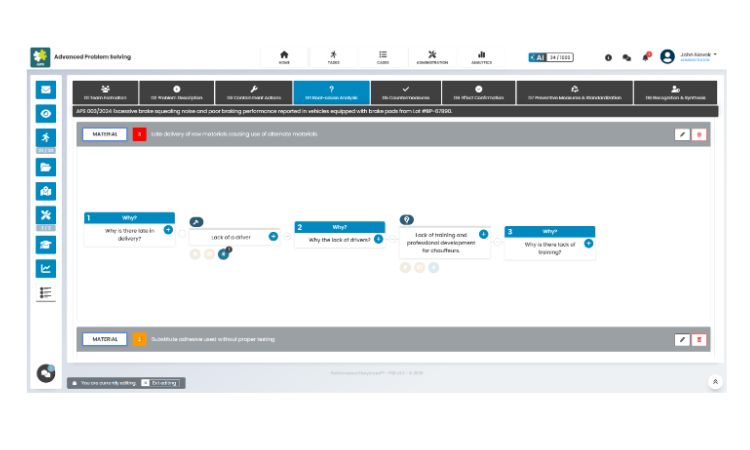
Companies that rely on opinions end up solving symptoms.
Companies that rely on facts solve root causes.
If the goal is long-term stability, fewer losses, less firefighting, and higher performance, then a structured, data-driven approach – supported by a solution like Advanced Problem Solving – is the only logical direction.
And the best part? The results are measurable, verifiable, and consistently better.