Organizations today face increasingly complex operational challenges, from system failures to process inefficiencies. Identifying the real cause of a problem is often more difficult than fixing the symptoms. This is where root cause analysis (RCA) techniques become essential for structured problem solving.
Among these techniques, the 5 Whys method has been widely used to identify underlying issues by repeatedly asking “why” until the core problem is revealed. However, with growing data complexity, traditional methods are evolving. AI-powered 5 Whys analysis tools are emerging as a smarter way to analyze problems faster and with greater accuracy.
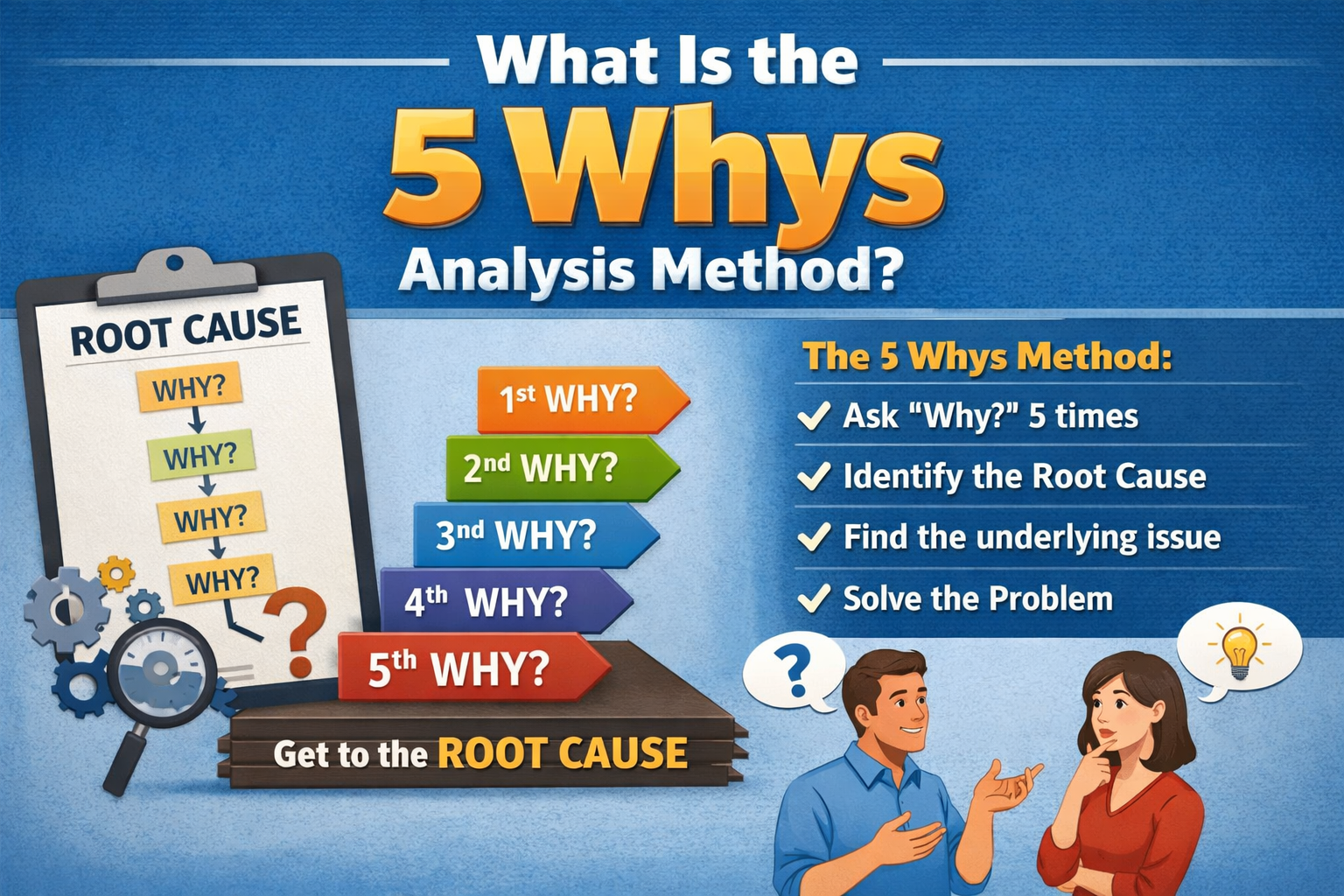
What Is the 5 Whys Analysis Method?
The 5 Whys technique is a simple but powerful method used to identify the root cause of a problem by asking “why” multiple times. Each answer forms the basis of the next question, helping teams move beyond surface-level symptoms. The goal is to trace the problem back to its origin so that effective solutions can be implemented.
Origins of the 5 Whys Technique
The 5 Whys method was originally developed within the Toyota Production System as part of lean manufacturing practices. It was designed to help teams quickly identify process failures and eliminate inefficiencies.
- Developed as part of Lean manufacturing principles
- Widely used in Six Sigma and quality management
- Helps teams focus on underlying process issues
How the 5 Whys Method Works
The process starts with defining a problem and asking why it occurred. Each answer becomes the starting point for the next question until the root cause becomes clear.
- Define the problem clearly
- Ask “why” repeatedly (typically five times)
- Identify the root cause behind the issue
Example of a Traditional 5 Whys Analysis
Consider a scenario where a website experiences downtime. By asking why repeatedly, teams can uncover the true cause rather than simply fixing the surface problem.
- Problem: Website crashed
- Why? Server overloaded
- Why? Sudden traffic spike
- Why? Marketing campaign launched without preparation
Limitations of Traditional 5 Whys Analysis
Although the 5 Whys technique is effective, it also has limitations when used in modern organizations. Complex systems generate huge volumes of data, and manual analysis can become slow and biased. Teams may also stop questioning too early or miss hidden factors.
Human Bias in Root Cause Investigation
When people conduct analysis manually, their assumptions and limited experience can influence conclusions. This can lead to incomplete or inaccurate root cause identification.
- Investigators may stop too early
- Personal bias may influence answers
- Important data may be overlooked
Time-Consuming Manual Analysis
Traditional root cause analysis often requires multiple meetings, discussions, and documentation. In fast-paced environments, this delay can slow down decision-making and problem resolution.
- Requires team collaboration and discussion
- Takes time to gather and analyze information
- Slows response during critical incidents
How AI Is Transforming Root Cause Analysis
Artificial intelligence is transforming how organizations investigate problems. Instead of relying only on manual questioning, AI systems can analyze large datasets, detect patterns, and recommend possible root causes.
AI-powered platforms can also guide teams through structured analysis workflows, improving accuracy and efficiency. This shift is enabling faster and more reliable problem diagnosis across industries.
Automated Pattern Detection
AI tools can analyze logs, system data, and operational metrics to detect patterns that humans might miss. This capability helps organizations identify recurring issues quickly.
- Analyzes large volumes of operational data
- Detects hidden patterns and correlations
- Identifies potential root causes automatically
Intelligent Question Generation
Modern AI tools can generate relevant “why” questions based on available data. This ensures that the investigation process remains structured and focused.
- Suggests relevant follow-up questions
- Guides users through investigation steps
- Reduces dependency on expert knowledge

What Are AI-Powered 5 Whys Analysis Tools?
AI-powered 5 Whys tools combine traditional problem-solving methods with artificial intelligence technologies such as machine learning and natural language processing. These tools help automate the root cause analysis process while maintaining the logic of the original methodology.
Platforms like Performance Storyboard integrate intelligent data analysis with visual workflows, allowing teams to investigate issues efficiently and collaboratively. Instead of manually tracking causes, the system assists users in identifying relationships between events and outcomes.
Key Capabilities
These tools provide advanced features that enhance the traditional 5 Whys approach and make problem-solving more data-driven.
- AI-generated “why” questions
- Real-time problem analysis
- Visual root cause mapping
- Integration with business data systems
Key Benefits of AI-Powered 5 Whys Tools
Organizations adopting AI-based root cause analysis gain several advantages over traditional methods. These tools improve both the speed and accuracy of investigations while reducing manual effort.
Solutions such as Performance Storyboard help teams transform raw data into actionable insights, enabling faster decision-making and improved operational efficiency.
Faster Root Cause Identification
AI systems can process large datasets within seconds, helping teams identify issues more quickly than manual analysis.
- Faster diagnosis of operational problems
- Reduced downtime and disruption
Reduced Human Bias
Data-driven analysis ensures that conclusions are based on facts rather than assumptions. This leads to more reliable problem-solving outcomes.
- Objective insights based on data
- More consistent analysis results
- Improved decision-making accuracy
Future of AI in Root Cause Analysis
The future of root cause analysis is becoming increasingly intelligent and automated. As AI technologies continue to advance, organizations will be able to detect and resolve problems even before they occur.
With platforms like Performance Storyboard, businesses can move toward predictive analysis, where systems continuously monitor operations and identify potential risks in advance. This proactive approach will help organizations improve reliability, efficiency, and long-term performance.