Digital Gemba Walk: From Observation to Action
Digital Gemba Walk are a Core Leadership Practices in Lean organizations. Their purpose is simple but powerful: leaders go to the place where work is actually done, observe reality, talk to people, and learn from facts — not from reports or assumptions.
The word Gemba comes from Japanese and literally means the actual place. A Gemba Walk is therefore not about judging, blaming, or auditing people. It is about understanding what is really happening in the process and supporting teams where they struggle.
Yet in many organizations, Gemba Walks fail to deliver real value.
Why leaders must go to Gemba
During a proper Gemba Walk, leaders do a few essential things:
- they observe reality as it is,
- they listen to people and ask open questions,
- they verify facts directly at the workplace,
- and they connect observations with performance indicators.
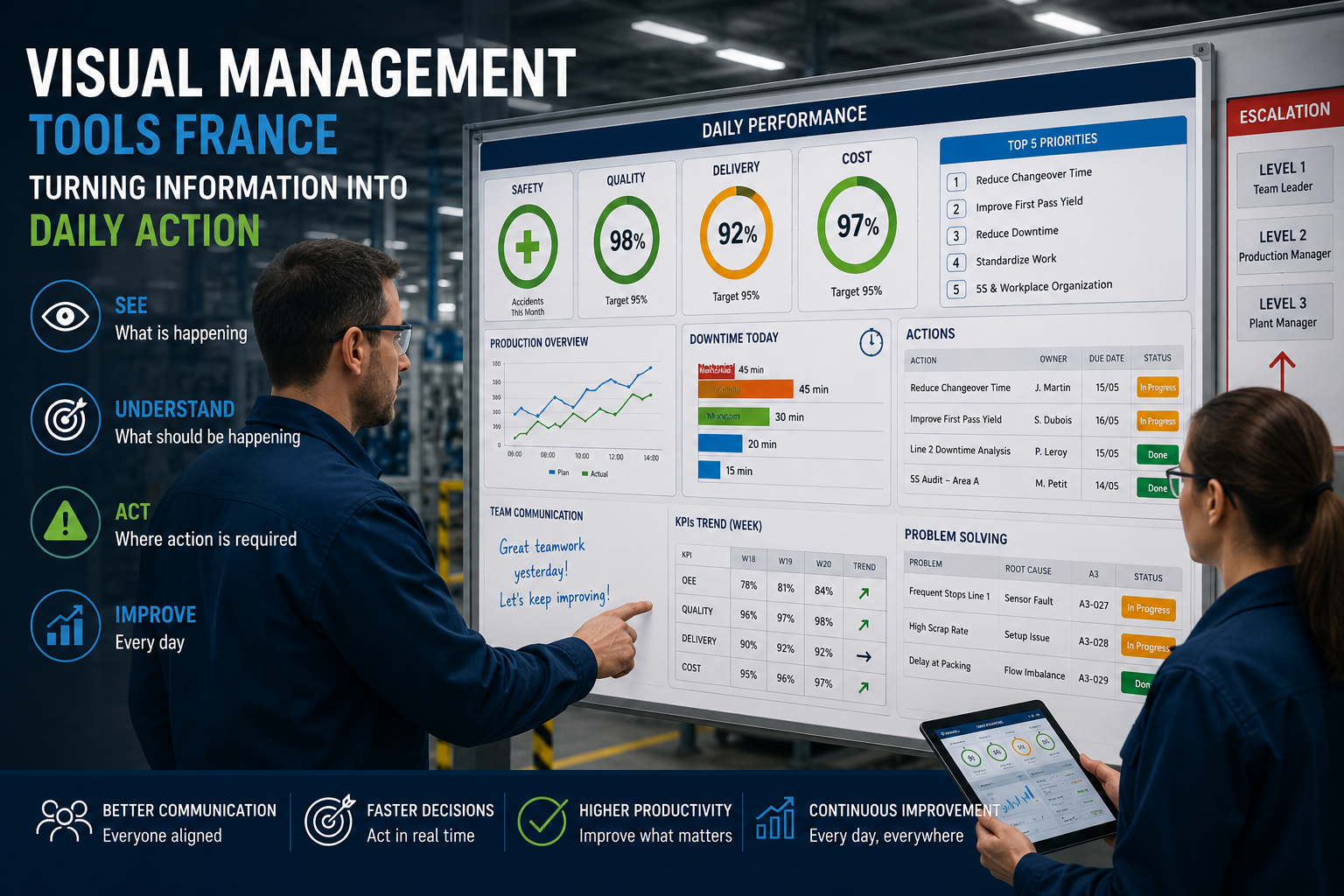
A typical starting point is the shopfloor or performance board where KPIs are visualized. When a leader sees a deviation — a red indicator, a missed target — the Gemba Walk should not stop at the explanation. The next step is to go to the process or the machine and see what actually happened.
Decisions must be based on real conditions, not interpretations.
This is why Gemba Walks are not audits. Their purpose is not to find nonconformities or assign blame, but to help people, improve processes, and strengthen the system.
Gemba Walk as a leadership practice
At its core, Gemba is about learning, supporting, and improving. The expected outcome is not just a corrective action, but:
- better processes,
- better communication,
- improved skills,
- and stronger leadership behavior.
When leaders change their mindset and behavior at Gemba, organizations start to change as well.
The real issue behind ineffective Gemba Walks is often not the method itself, but insufficient leadership presence at the place where value is created.
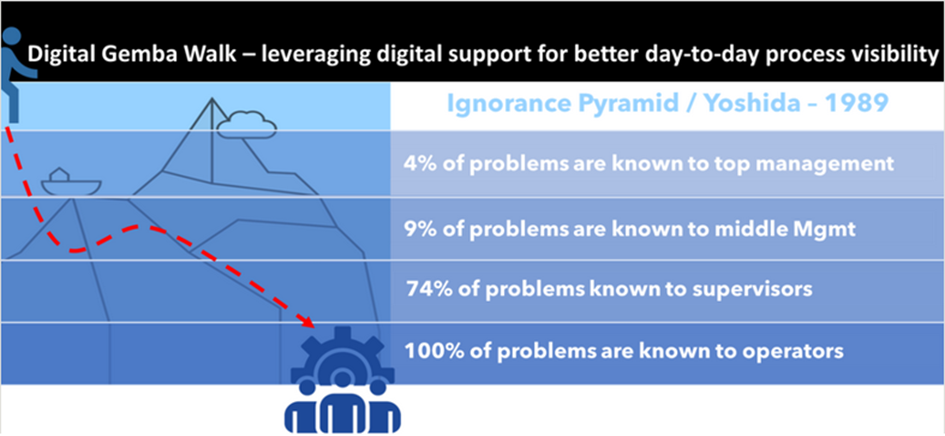
This is well illustrated by the well-known Yoshida Iceberg of Ignorance: most problems are known at the operator level, while only a small fraction reaches top management. Not because people hide issues, but because information gets lost when leaders are not regularly present at Gemba.
Common challenges in traditional Gemba Walks
In practice, organizations face recurring challenges:
- Gemba Walks are performed inconsistently or without structure
- They depend on individual discipline and are skipped when schedules are busy
- They turn into audits or compliance checks instead of learning conversations
- Observations are written in notebooks or on paper and later lost
- There is little or no connection to KPIs and performance goals
Without structure and follow-up, Gemba becomes “just a walk”.
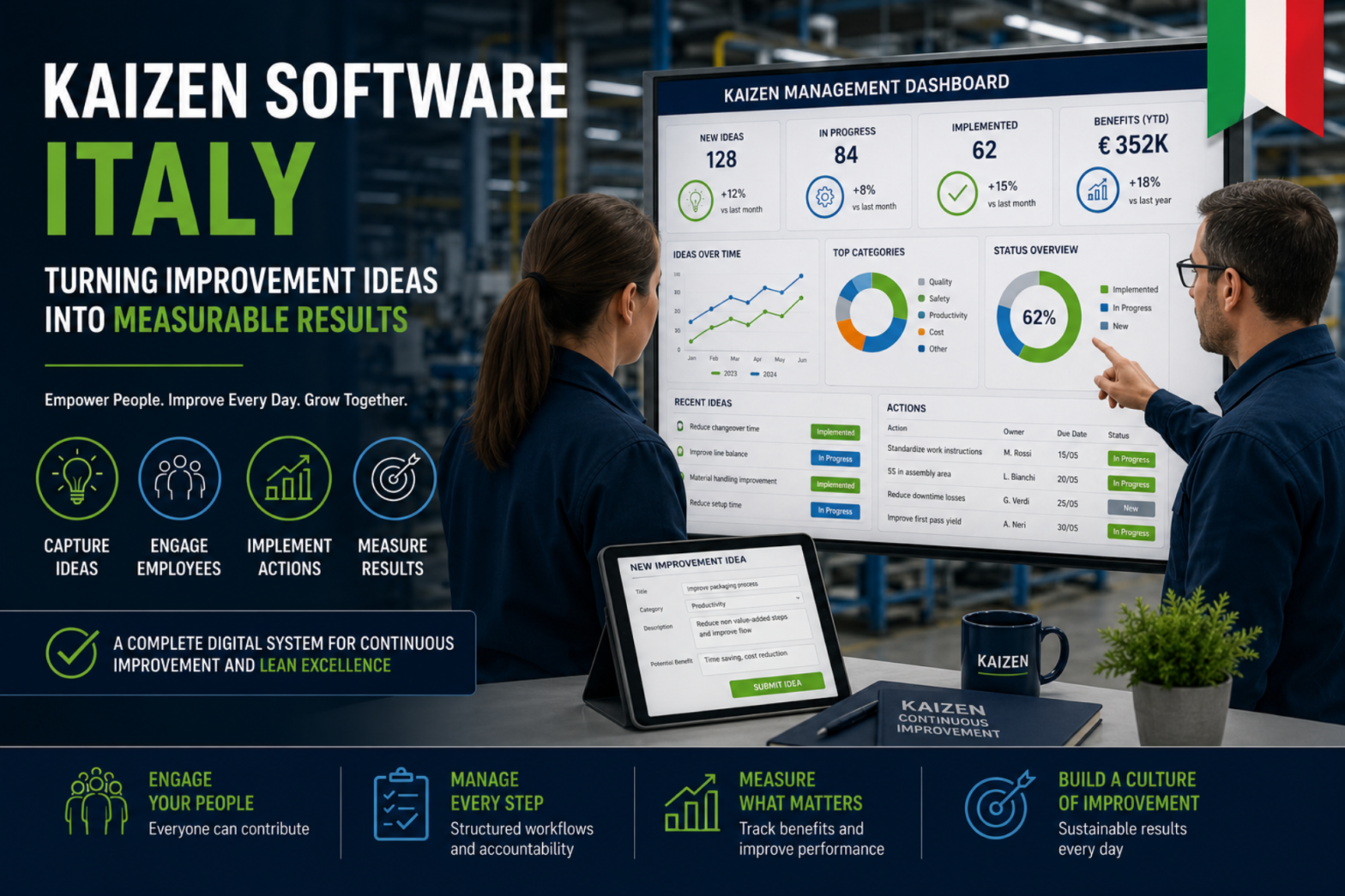
Read more: Kaizen software Italy in Workplace: From Gemba Walks to Digital Dashboards
From Gemba Walk to closed-loop execution
A good Gemba Walk does not start on the shopfloor — it starts with preparation.
Leaders must be clear about:
- why they are going to Gemba,
- what the purpose of the walk is,
- and what they want to learn or improve.
Respect comes first. Process owners are partners, not spectators. The focus is on processes and data, not on people. Problems are in processes, not in individuals.
Structured questions help reveal what is often overlooked, especially potential risks and future problems — not only today’s issues. Listening is more important than talking, and feedback must be constructive.
Most importantly: without follow-up, Gemba is only a walk. Standardization and disciplined follow-up are essential parts of leadership standard work.
Why digitalize the Gemba Walk
Digitalizing the Gemba Walk does not mean “just using software”. It is a holistic change that includes process, mindset, skills, and leadership routines.
Digital support helps organizations:
- standardize Gemba Walk execution
- document observations consistently
- connect findings with KPIs and goals
- manage actions and follow-up transparently
- analyze recurring issues over time
With digital tools, Gemba Walks become part of a closed PDCA loop — from planning and observation to action, standardization, and learning.
Digital Gemba Walk in practice
With digital support, leaders can:
- plan Gemba Walks in advance,
- use structured questionnaires adapted to different focus areas (e.g. safety, quality, processes),
- capture findings directly on-site using mobile devices,
- attach photos and evidence,
- create and track actions with clear ownership and deadlines,
- and connect Gemba results with performance indicators.
This creates full transparency — not only for individual walks, but across history, locations, and teams.
Conclusion of Core Leadership Practices
Gemba Walks only create value if they lead to action.
Digital Gemba Walks bring structure, visibility, and discipline into a leadership practice that is often well understood in theory, but poorly executed in reality. They help leaders move away from opinions and assumptions, and manage performance based on facts, data, and direct observation.
Digital support does not replace leadership — it strengthens it.
In practice, this is where DAM – Daily Audit Management supports leaders.
It enables structured digital Gemba Walks, links observations directly to KPIs and actions, and ensures disciplined follow-up — turning Gemba from an occasional activity into a reliable leadership routine.