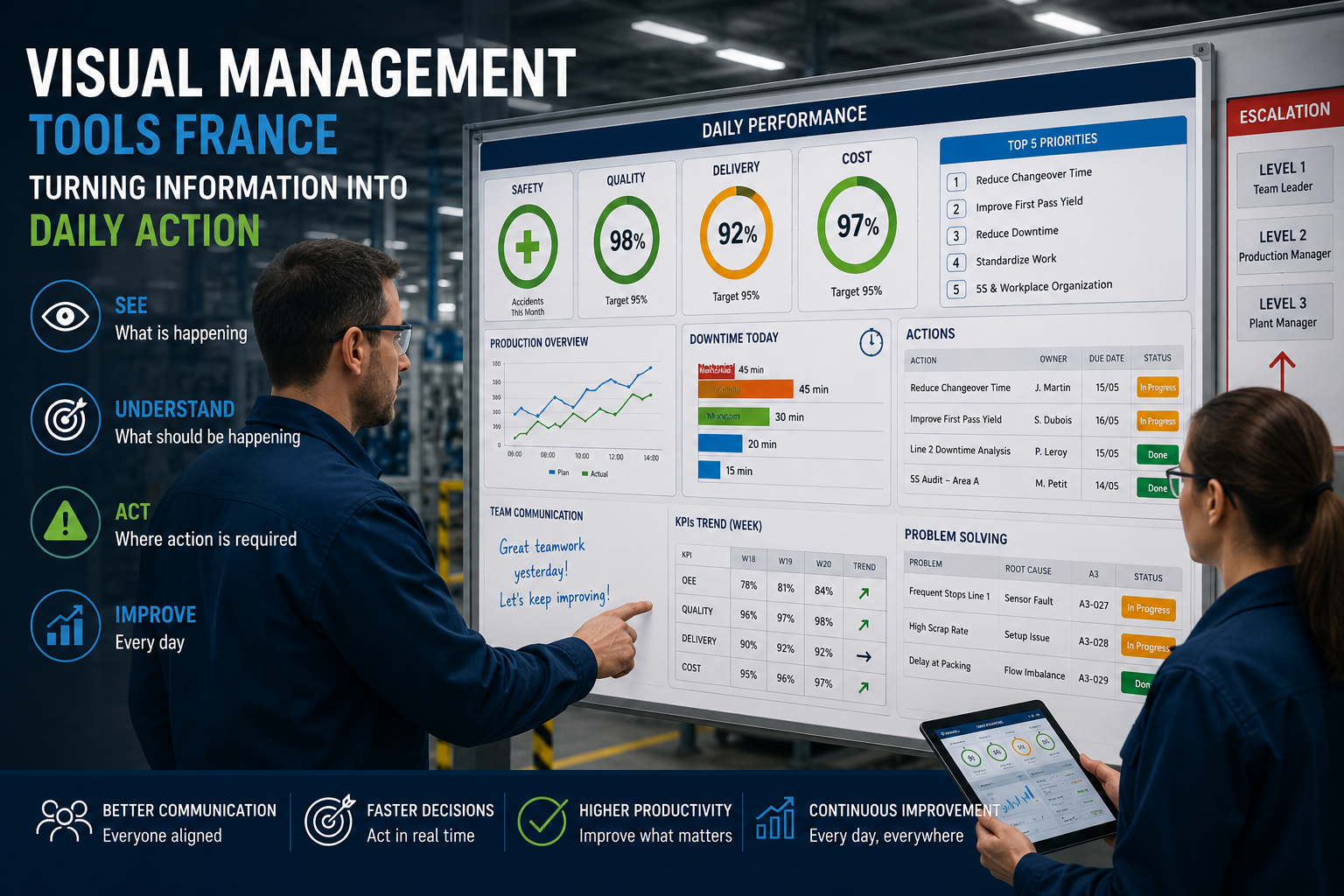
When companies refer to Shopfloor Management, most people immediately think of the morning meeting in front of a performance board.
Typically, it consists of a short KPI review, a few comments, perhaps a note about a deviation — and the day begins.
Structured. Organized. Even disciplined.
But if Shopfloor Management is reduced to those fifteen minutes, its true purpose is misunderstood.
Real Shopfloor Management does not begin and end at the board.
The board is only a tool. The meeting is only a moment.
Shopfloor Management is the complete scope of operational leadership — the way a manager assumes responsibility for production performance every single day.
A Production Manager Is Not a “Reader of KPIs”
Within a structured Daily Management System, a production leader does far more than monitor numbers.
Every day, the manager is responsible for:
- People Safety
- Product Quality
- Production Stability and Efficiency
- Cost Control
- Team Development and Engagement
These are not optional priorities.
They are the five core pillars of effective Lean Management in production.
What Effective Shopfloor Management Really Means
In a mature Shopfloor Management system:
- Safety means proactively identifying and eliminating risks.
- Quality means building process reliability — not just tracking defect rates.
- Efficiency means stable flow, not constant firefighting.
- Cost management means systematic waste elimination.
- People development means building competence and ownership.
This requires structured leadership routines — not improvisation.
The Role of Leadership Standard Work
Sustainable Shopfloor Management depends on Leadership Standard Work.
Just as operators follow standardized work procedures, leaders must operate within clearly defined:
- Daily routines
- Weekly routines
- Monthly routines
Leadership Standard Work defines:
- When process audits are performed
- When gemba walks take place
- How deviations are addressed
- When problems are escalated
- How coaching (e.g., KATA coaching) is executed
- How open actions are reviewed
- How team competencies are developed
This transforms leadership from personality-driven to system-driven.
With Leadership Standard Work, managers no longer rely on memory, mood, or pressure.
They rely on structure.
The Foundation: Daily Management System
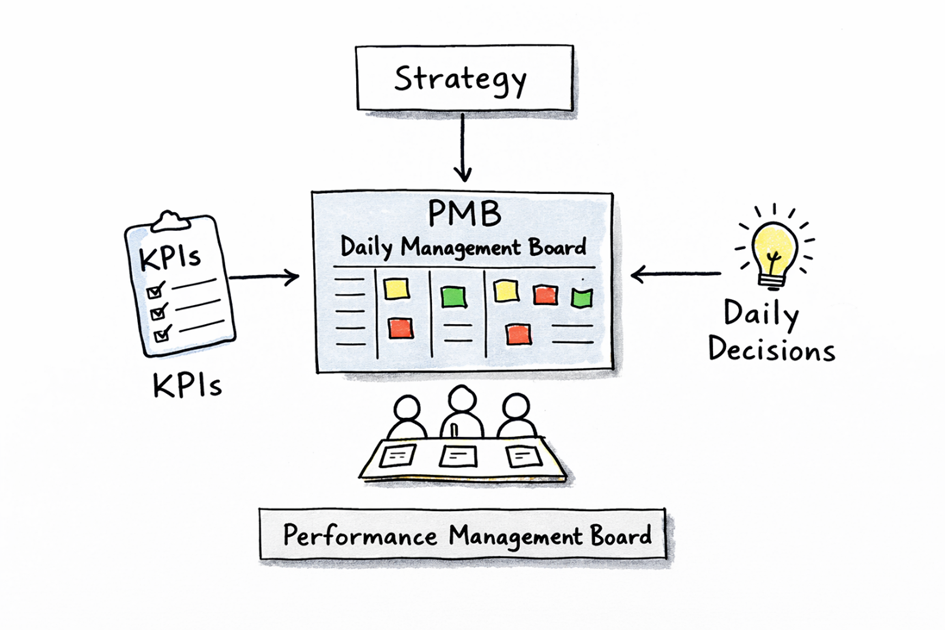
Shopfloor Management operates within a broader Daily Management System (DMS).
A strong Daily Management System:
- Connects all management levels
- Aligns operational KPIs with strategic objectives
- Ensures daily actions support long-term goals
Without a structured Daily Management System, even capable managers struggle to maintain consistency.
With it, leadership becomes predictable, repeatable, and scalable.
From Traditional Boards to Digital Lean Management
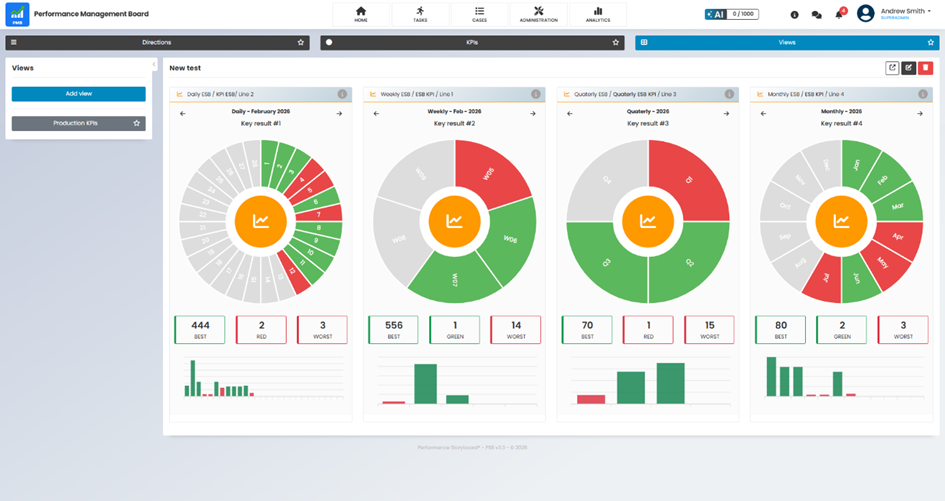
When Shopfloor Management, Leadership Standard Work, and a Daily Management System are digitally supported, performance visibility and execution improve significantly.
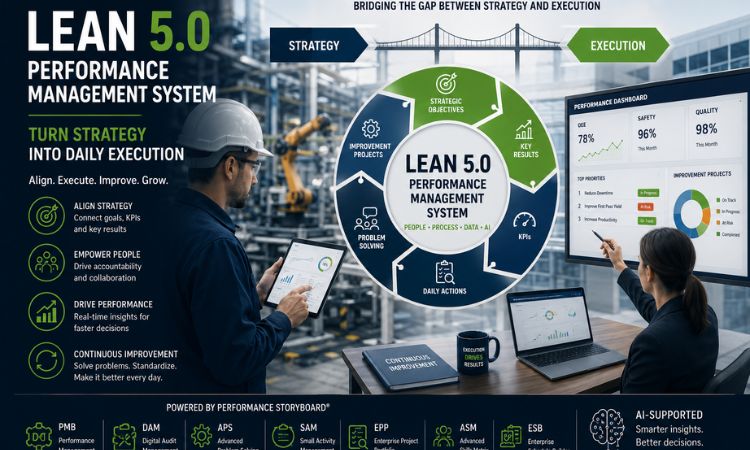
This is where Performance Storyboard® plays a strategic role.
Performance Storyboard transforms traditional Shopfloor Management into an integrated Digital Lean Management System, where:
- Strategic goals
- Operational KPIs
- Corrective actions
- Escalations
- Structured problem-solving (A3, 8D, PDCA)
are connected within one unified environment.
Leadership becomes:
- Transparent
- Traceable
- Measurable
- Action-oriented
across all organizational levels.
The board is no longer just physical.
Execution is no longer reactive.
Leadership becomes systemic.
When Leadership Becomes a System
True Shopfloor Management is where strategy meets operational reality.
When supported by:
- Leadership Standard Work
- A structured Daily Management System
- A digital platform such as Performance Storyboard®
production leadership evolves from reactive management to proactive control.
Processes stabilize.
Problems are addressed early.
People develop continuously.
Performance becomes predictable.
When leadership becomes a system, production does not react to events.
It manages them.