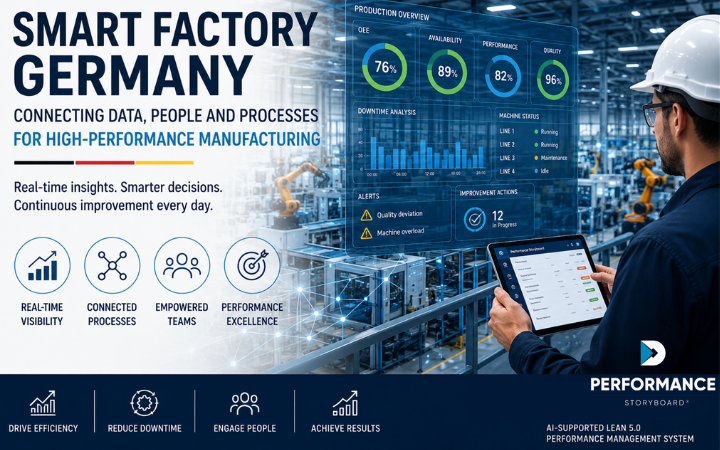
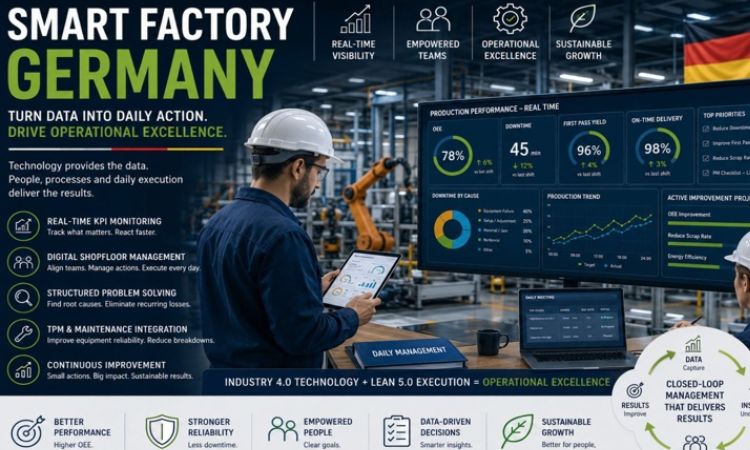
A compelling opening paragraph introducing smart factories as the cornerstone of Germany’s manufacturing excellence, highlighting how digital transformation is revolutionizing production through Industry 4.0 technologies. Mention how Performance Storyboard supports this transformation through comprehensive smart factory Germany solutions.
The Smart Factory Evolution: From Industrie 4.0 to 5.0
This section explores the historical progression of manufacturing automation, from early mechanization to today’s intelligent, interconnected production systems. Germany’s Industrie 4.0 initiative has set global standards, and now Industry 5.0 emphasizes human-centricity and sustainability alongside technological advancement.
Key Points:
- Timeline of industrial revolutions: 1.0 through 5.0
- Germany’s Industrie 4.0 framework and its global impact
- Transition from automation-focused 4.0 to human-centric 5.0
- How Performance Storyboard bridges Industry 4.0 and 5.0 principles
- Key differences between traditional factories and smart factories
Deutschland’s Smart Manufacturing Advantage
Germany’s manufacturing sector leads globally due to precision engineering, strong SME networks, and government-industry collaboration. This section examines why German smart factories set benchmarks for quality, efficiency, and innovation worldwide.
Key Points:
- Germany’s manufacturing heritage and reputation for quality
- Government initiatives supporting digital transformation (e.g., Plattform Industrie 4.0)
- Strong collaboration between research institutions and industry
- German engineering precision meets digital innovation
- Regional manufacturing clusters and innovation hubs
- How Performance Storyboard aligns with German quality standards
Core Technologies: IoT, Connectivity, and Data
The foundation of any smart factory Germany lies in its technological infrastructure. This section details the interconnected systems that enable real-time data flow, machine communication, and intelligent decision-making across the production environment.
Key Points:
- Industrial Internet of Things (IIoT) architecture and sensors
- 5G and industrial connectivity solutions
- Edge computing vs. cloud computing in manufacturing
- Big Data analytics and real-time processing
- Digital twins and virtual simulation
- Cybersecurity in connected factories
- Performance Storyboard’s integration with IoT ecosystems
AI Automation in Smart Factories
Artificial intelligence transforms raw data into actionable insights, enabling predictive maintenance, quality control, and autonomous operations. This section explores how AI and machine learning optimize production processes in German smart factories.
Key Points:
- Machine learning for predictive maintenance
- Computer vision for quality inspection
- AI-driven production scheduling and optimization
- Autonomous mobile robots (AMRs) and AGVs
- Natural language processing for human-machine interaction
- Performance Storyboard’s AI-powered analytics features
Smart Factory Solutions and Use Cases
Real-world applications demonstrate the tangible benefits of smart factory Germany implementation. This section showcases specific solutions and industry examples from Germany’s manufacturing landscape.
Key Points:
- Automotive industry smart factory examples (BMW, Mercedes, VW)
- Chemical and pharmaceutical smart manufacturing
- Electronics and precision engineering applications
- Food and beverage production automation
- Custom manufacturing and mass customization
- ROI metrics and performance improvements
- Performance Storyboard customer success stories
Building the Smart Factory: Implementation Strategy
Transforming a traditional facility into a smart factory Germany requires careful planning, phased implementation, and change management. This section provides a roadmap for manufacturers beginning their digital transformation journey.
Key Points:
- Maturity assessment and readiness evaluation
- Phased implementation approach (crawl-walk-run)
- Infrastructure requirements and technology stack
- Data standardization and interoperability (OPC UA, AutomationML)
- Pilot projects and scaling strategies
- Budget planning and ROI calculation
- How Performance Storyboard facilitates seamless implementation
Read more : Streamline Quality and Eliminate Recurring Issues with AI-Powered 8D Problem-Solving Software
Human-Centric Smart Factory: People and Robots Working Together
Industry 5.0 emphasizes collaboration between humans and machines, recognizing that people remain central to innovation and problem-solving. This section explores the evolving role of workers in smart factories.
Key Points:
- Collaborative robots (cobots) and human-robot interaction
- Augmented reality (AR) for training and maintenance
- Upskilling and reskilling workforce programs
- Ergonomics and worker safety improvements
- Employee engagement in continuous improvement
- Performance Storyboard tools supporting team collaboration
Challenges and Best Practices
Every transformation faces obstacles. This section addresses common challenges in smart factory Germany implementation and provides proven strategies for overcoming them based on German manufacturing experience.
Key Points:
- Legacy system integration challenges
- Data quality and standardization issues
- Cybersecurity threats and mitigation
- Skills gaps and training requirements
- Change management and organizational culture
- Investment justification and budget constraints
- Best practices from German Mittelstand companies
- Performance Storyboard’s approach to addressing these challenges
Future Outlook: Industry 5.0 and Sustainable Production
The future of smart manufacturing balances technological advancement with environmental responsibility and human wellbeing. This section explores emerging trends shaping Germany’s industrial landscape.
Key Points:
- Sustainability and circular economy integration
- Carbon-neutral manufacturing initiatives
- Advanced AI and quantum computing potential
- 6G connectivity and future communication technologies
- Personalization and on-demand manufacturing
- Resilient and adaptable supply chains
- Performance Storyboard’s vision for future-ready factories
Conclusion – smart factory Germany
A powerful closing paragraph summarizing Germany’s smart factory Germany leadership and the transformative impact of digital manufacturing. Reinforce how Performance Storyboard empowers manufacturers to achieve operational excellence through comprehensive smart factory solutions, bridging the gap between Industry 4.0 technology and Industry 5.0 human-centric values.
Key Points:
- Recap of Germany’s smart factory advantages
- The imperative for digital transformation
- Performance Storyboard’s role as a trusted partner
- Call-to-action for manufacturers to begin their journey
Contact Us – smart factory Germany
Performance Storyboard – Your Smart Factory Partner
Ready to transform your manufacturing operations with smart factory Germany solutions? Our team of experts is here to guide you through every step of your digital transformation journey.
📧 Email: [ps*@*************ay.com]
📞 Phone: [+386 (0)7 30 73 081]
🌐 Website: https://performance-storyboard.com/
Get Started Today:
- Schedule a free consultation
- Request a demo of Performance Storyboard solutions
- Download our Smart Factory Implementation Guide
Frequently Asked Questions (FAQ) – smart factory Germany
Q1. What is a smart factory?
Ans: A smart factory Germany is a highly digitized and connected production facility that uses technologies like IoT, AI, robotics, and data analytics to create an intelligent, adaptive manufacturing environment. Smart factories enable real-time monitoring, predictive maintenance, and autonomous decision-making.
Q2. What is the difference between Industry 4.0 and Industry 5.0?
Ans: Industry 4.0 focuses on automation, digitalization, and cyber-physical systems. Industry 5.0 builds upon this by emphasizing human-centric approaches, sustainability, and collaboration between humans and machines, creating a more balanced and responsible manufacturing ecosystem.
Q3. Why is Germany a leader in smart factory technology?
Ans: Germany combines engineering excellence, strong government support through initiatives like Plattform Industrie 4.0, robust collaboration between industry and research institutions, and a thriving SME sector that drives innovation in manufacturing technology.
Q4. What technologies are essential for a smart factory?
Ans: Core technologies include Industrial IoT (IIoT) sensors, connectivity infrastructure (5G, industrial Ethernet), edge and cloud computing, AI and machine learning, digital twins, robotics, AR/VR, and comprehensive data analytics platforms like Performance Storyboard.
Q5. How much does it cost to implement a smart factory?
Ans: Costs vary widely based on factory size, existing infrastructure, and automation level. Implementation can range from €50,000 for small pilot projects to millions for complete facility transformations. Performance Storyboard offers scalable solutions to fit different budgets and phased implementation approaches.