Most companies do not suffer from a lack of improvement ideas.
They suffer from a lack of execution.
Every day, employees identify waste, quality issues, safety risks, unnecessary activities and opportunities to improve performance. Yet in many organizations, these ideas never become implemented improvements. Suggestions are forgotten, actions are delayed and the impact is rarely measured.
This is one of the main reasons why many Continuous Improvement programs lose momentum after an initial period of enthusiasm.
The challenge is not generating ideas.
The challenge is creating a system that consistently transforms ideas into measurable business results.
Kaizen Is Not a Suggestion Box
Many organizations still associate Kaizen with suggestion forms, occasional workshops or isolated improvement projects.
This is a common misunderstanding.
Kaizen is not an event.
Kaizen is not a project.
Kaizen is a management philosophy focused on creating a culture of continuous improvement where everyone contributes to improving processes, quality, safety, productivity and customer value.
The most successful organizations do not treat improvement as something extra. Improvement becomes part of daily work.
Employees continuously identify opportunities, leaders remove barriers, and management systems ensure that ideas become actions.
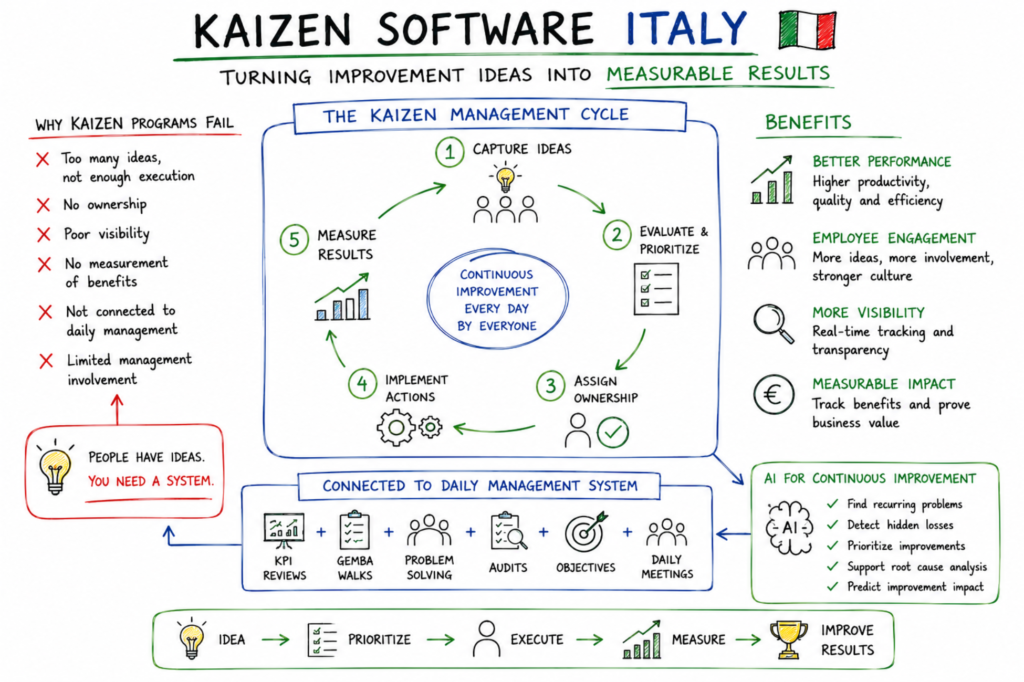
Why Kaizen Programs Often Fail
Many companies invest significant effort into Lean and Continuous Improvement initiatives but struggle to sustain results.
The most common reasons include:
- Too many ideas and not enough execution
- Limited management involvement
- Lack of ownership and accountability
- Poor visibility of improvement activities
- No measurement of improvement benefits
- Weak connection between improvement initiatives and business objectives
- Improvement projects operating independently from daily management
Without a structured system, even the best ideas eventually disappear.
Organizations need more than enthusiasm.
They need a process.
What Is Kaizen Software?
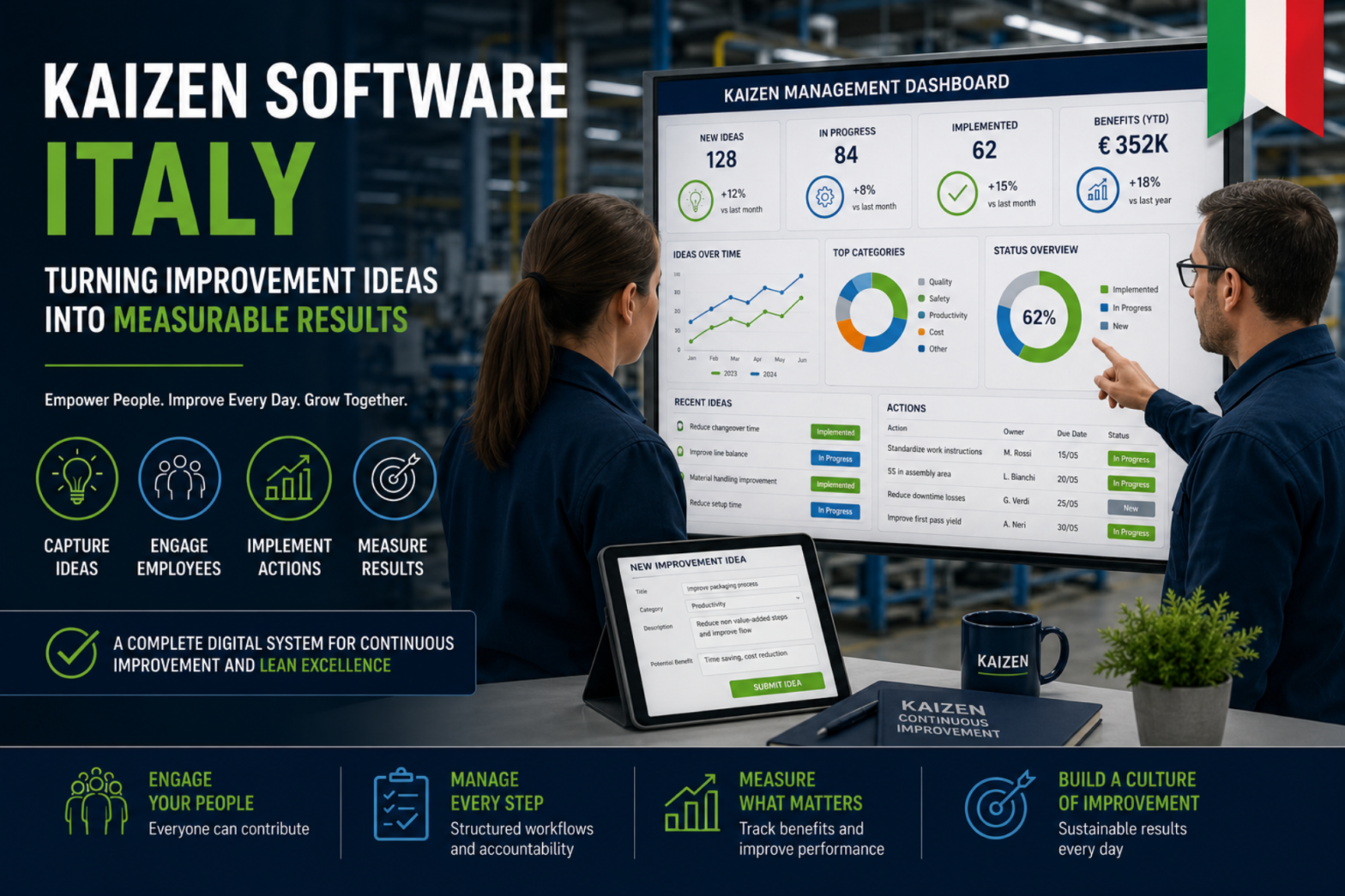
Kaizen Software is a digital platform designed to manage the complete continuous improvement lifecycle.
Instead of relying on spreadsheets, emails, paper forms and disconnected databases, organizations can centralize all improvement activities within one system.
Modern Kaizen software helps organizations:
- Capture employee ideas
- Prioritize improvement opportunities
- Assign ownership
- Track implementation progress
- Measure business impact
- Monitor Continuous Improvement KPIs
- Improve collaboration across departments
The objective is not collecting ideas.
The objective is delivering measurable results.
From Ideas to Measurable Improvement
One of the biggest mistakes organizations make is focusing exclusively on idea generation.
The real value of Kaizen is created when ideas become implemented solutions.
A successful Kaizen process typically follows five stages:
1. Capture Improvement Opportunities
Employees identify waste, inefficiencies, quality issues or improvement opportunities directly within their work environment.
2. Evaluate and Prioritize
Ideas are assessed based on business impact, feasibility and alignment with organizational objectives.
3. Assign Responsibility
Clear ownership, deadlines and expectations are established.
4. Execute Improvement Actions
Teams implement corrective actions and monitor progress.
5. Measure Results
Benefits are measured using operational, financial and performance indicators.
This structured approach significantly increases the success rate of improvement initiatives.
Practical Example: Increasing Employee Engagement in Continuous Improvement
A manufacturing company implemented a traditional suggestion system to encourage employee involvement.
Initial Situation
- Less than ten improvement suggestions per month
- No standardized evaluation process
- Limited feedback to employees
- Difficult tracking of implementation status
- No reliable measurement of benefits
Implemented Solution
The organization introduced a digital Kaizen platform connected to daily management routines.
Employees could submit ideas digitally, managers could review and prioritize suggestions, and improvement actions were automatically tracked.
Results
- Fourfold increase in employee participation
- Faster implementation of improvement initiatives
- Improved visibility for management
- Better collaboration between departments
- Stronger Continuous Improvement culture
The biggest lesson was simple:
People already had ideas.
The organization simply lacked a system to manage them effectively.
Connecting Kaizen with Daily Management
One of the most important success factors is integrating Kaizen into daily operations.
Many improvement systems fail because they operate separately from normal business processes.
The most successful organizations connect Kaizen with:
- Daily Management Systems (DMS)
- Shopfloor Management
- Gemba Walks
- KPI Reviews
- Problem Solving
- Lean Audits
- Operational Excellence Programs
This creates a continuous improvement engine rather than a collection of isolated projects.
The Growing Role of AI in Continuous Improvement
Artificial Intelligence is creating new opportunities for Continuous Improvement programs.
Modern organizations are beginning to use AI to:
- Identify recurring problems
- Detect hidden operational losses
- Prioritize improvement opportunities
- Support Root Cause Analysis
- Analyze employee suggestions
- Identify performance trends
- Recommend corrective actions
AI does not replace human creativity.
It helps organizations focus improvement efforts where they create the greatest impact.
This approach aligns closely with the principles of Lean 5.0, where technology supports people rather than replacing them.
Kaizen and Lean 5.0
Traditional Lean initiatives focused primarily on process optimization and waste reduction.
Lean 5.0 expands this perspective by emphasizing:
- Human-centered improvement
- Digital support systems
- AI-assisted decision-making
- Competence development
- Organizational resilience
- Sustainable operational performance
The future belongs to organizations that successfully combine Lean principles, employee engagement and digital technologies.
How Performance Storyboard Supports Digital Kaizen
Many improvement platforms focus solely on collecting ideas.
Performance Storyboard® takes a broader approach.
Continuous Improvement rarely fails because of a lack of ideas.
It fails because improvement activities remain disconnected from operational management systems.
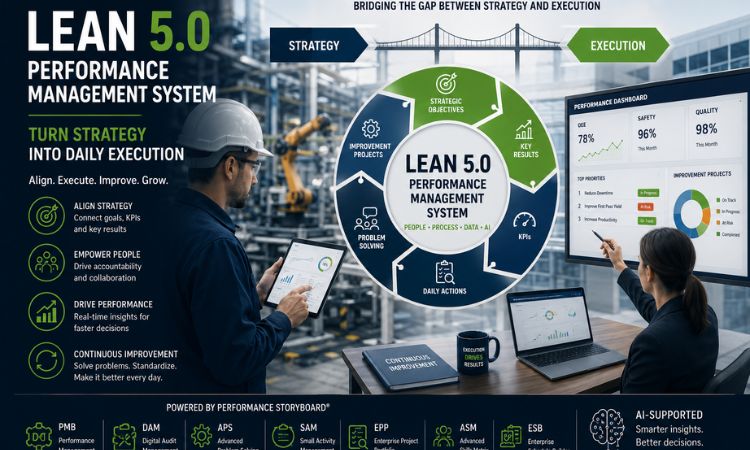
Performance Storyboard® connects:
- Improvement suggestions
- Strategic objectives
- Key Results
- KPIs
- Audits
- Problem Solving
- Improvement Projects
- Competence Management
- Tasks and Actions
- Daily Management Systems
within a single AI-supported Lean 5.0 Performance Management System.
This enables organizations to transform isolated improvement activities into a sustainable culture of operational excellence.
Benefits of Digital Kaizen Software
Organizations that successfully digitalize Continuous Improvement typically achieve benefits in three critical areas.
Operational Benefits
- Faster implementation of improvements
- Reduced waste
- Improved productivity
- Better quality performance
- Increased process stability
Employee Benefits
- Higher engagement
- Greater ownership
- Stronger collaboration
- Increased participation in improvement initiatives
Business Benefits
- Better visibility of improvement activities
- Stronger alignment with strategic objectives
- Improved profitability
- Greater competitiveness
- Sustainable operational excellence
Frequently Asked Questions
What is Kaizen Software?
Kaizen Software is a digital platform that helps organizations manage continuous improvement activities, employee ideas, improvement projects and measurable business results.
Is Kaizen Software suitable for SMEs?
Yes. Modern Kaizen solutions are scalable and can support both small organizations and large multinational enterprises.
How does Kaizen Software improve productivity?
By improving visibility, accountability and execution of improvement activities, organizations can implement changes faster and achieve measurable operational improvements.
Can Kaizen Software support Lean Manufacturing initiatives?
Absolutely. Kaizen Software is often used to support Lean Manufacturing, TPM, Operational Excellence and Continuous Improvement programs.
How does AI support Continuous Improvement?
AI helps organizations identify patterns, prioritize improvement opportunities, support Root Cause Analysis and improve decision-making.
The Future of Continuous Improvement in Italy
The organizations that will outperform competitors over the next decade will not necessarily be those with the most ideas.
They will be those that execute improvements most effectively.
The future of Continuous Improvement lies in combining employee knowledge, Lean methodologies, digital technologies and AI-supported decision-making into one integrated management system.
Because sustainable improvement is not created by collecting ideas.
It is created by turning ideas into measurable results.